Casual Blazer Outfits 2026 That Look Relaxed, Not Corporate

You know the moment: the jeans look good, the T-shirt is fine, but the outfit feels one step short of finished. You grab a blazer—and suddenly you’re wondering whether you look ready for Saturday lunch or an 8:30 a.m. staff meeting.

That tension is exactly why Casual Blazer Outfits can be surprisingly tricky. A blazer brings structure automatically, so everything surrounding it changes how formal that structure appears.

The good news is that you don’t need a special “casual blazer wardrobe.” In most cases, the easiest formula is a blazer plus one polished element and two or three visibly relaxed ones: denim, a simple tee, flat shoes, an easy bag, or softer tailoring. The real skill is knowing which details change the mood.

The Quick Answer

To style a blazer casually, pair its tailored structure with relaxed pieces such as straight-leg jeans, a crewneck T-shirt, sneakers, flats, or loose trousers. Softer shoulders, textured fabrics, uncomplicated layers, and non-matching bottoms also reduce formality. For a sharper version, keep the outfit casual but swap sneakers for loafers or streamlined boots.

What Actually Makes a Blazer Look Casual?
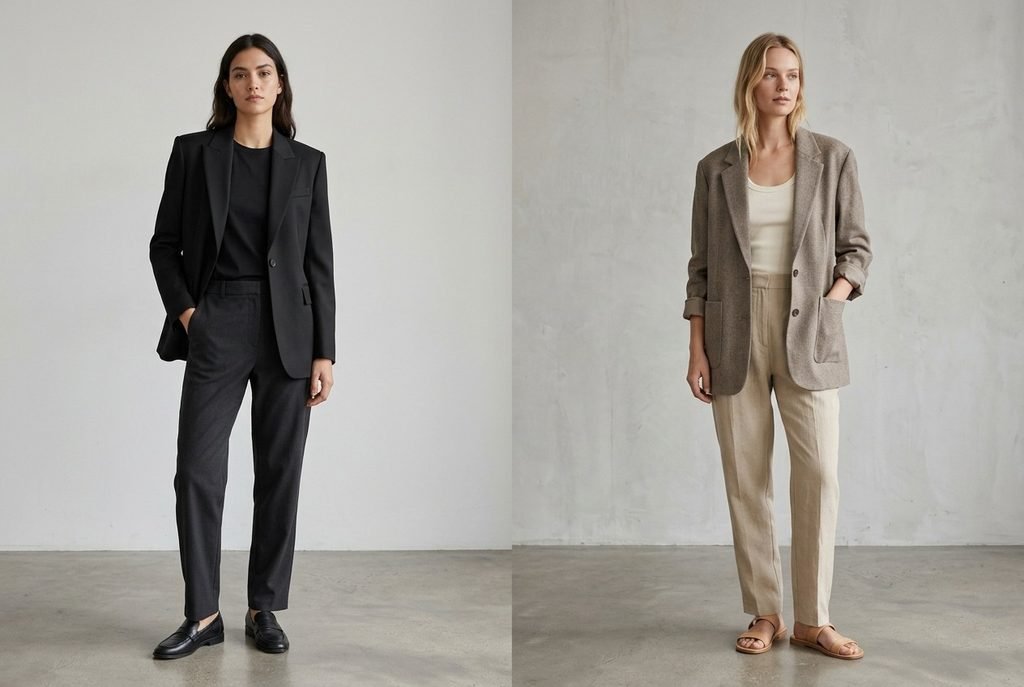
A blazer looks casual when the entire outfit contains enough relaxed visual cues to counterbalance the tailoring.

Think of formality as something the whole outfit creates—not a permanent property of the blazer. A sharp black jacket, silk blouse, matching trousers, structured handbag, and pointed pumps all reinforce one another. Change the trousers to faded denim and the blouse to a cotton tee, and the same jacket starts telling a different story.

Several details matter.

Shoulder construction: A strong, padded shoulder creates a cleaner architectural line and generally reads sharper. Softer or more natural shoulders tend to integrate more easily with casual clothes.

Fabric and texture: Smooth, crisp suiting fabrics often look dressier than linen, brushed wool, cotton twill, corduroy, or visibly textured weaves. That doesn’t mean you can’t casualize a polished blazer; you’ll simply need more contrast elsewhere.

Blazer length: Longer jackets naturally create more visual weight. They work especially well over slim, straight, or moderately wide bottoms. Cropped jackets expose more of the waist and can work well with high-rise trousers, full skirts, or wide-leg jeans.

Lapel and closure: Broad lapels and double-breasted fronts make more of a statement. Narrower or softer lapels and relaxed single-breasted cuts can disappear into an everyday outfit more easily. Neither option is inherently better.

What surrounds it: Jeans, sneakers, tees, ribbed tanks, knitwear, canvas totes, relaxed trousers, and uncomplicated jewelry all pull tailoring toward the casual end of the spectrum.

A useful rule: if almost every other piece could comfortably appear in a weekend outfit without the blazer, you’re probably on the right track.

Casual Blazer Outfits You Can Copy and Adjust

You don’t have to overthink it. Start with a formula, then change one piece according to the weather, occasion, or silhouette you prefer.

1. Navy blazer + white crewneck tee + straight-leg jeans + white sneakers
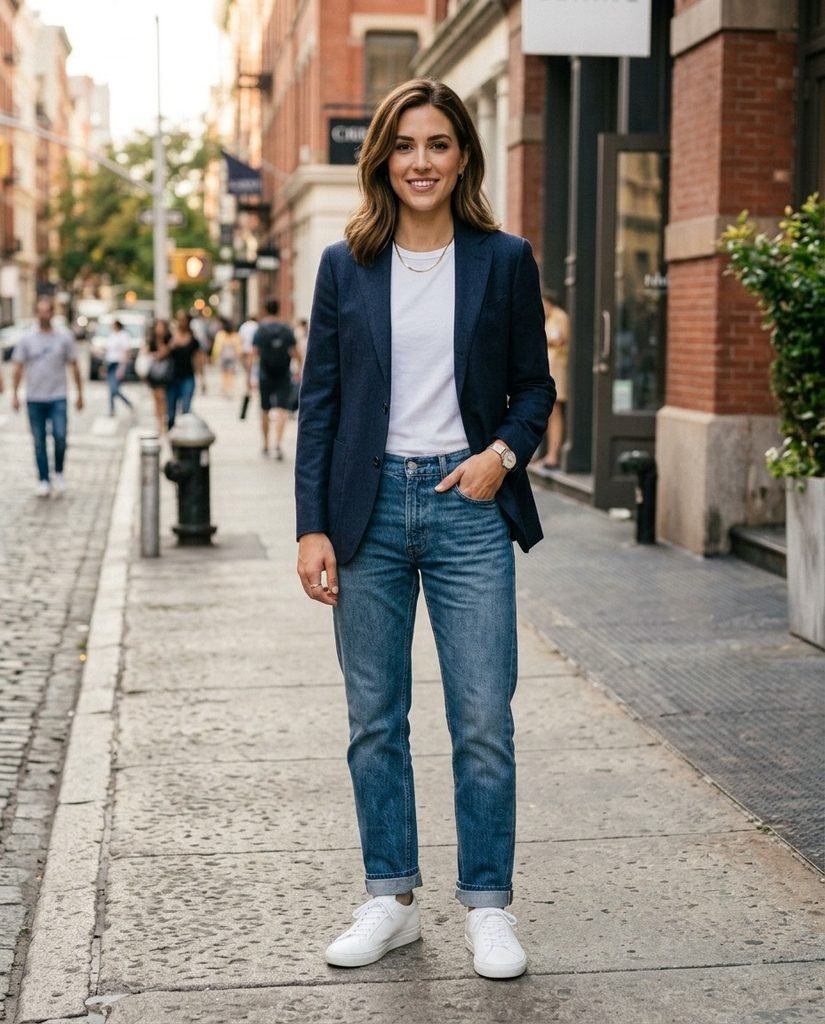
This combination works because the blazer supplies the structure while the tee, denim, and sneakers all move in the opposite direction.

Mid- or light-wash jeans make the contrast particularly clear. Dark, pristine denim will look a little sharper, which can be useful for a casual dinner or workplace where jeans are acceptable.

Wear it for lunch, errands, sightseeing, a casual meeting, or dinner somewhere that doesn’t require formal dress.

Try these swaps: Change white sneakers to loafers for more polish, or switch the white tee to gray for a quieter, lower-contrast palette.

2. Camel blazer + black tank + dark straight jeans + loafers

Here, the color combination does much of the work. Camel warms up black, while denim prevents the blazer-and-loafer pairing from becoming too businesslike.

A tank creates a clean vertical opening beneath the jacket without adding another collar or button placket. That matters: fewer formal details around the neckline can make a blazer feel considerably less corporate.

If loafers feel too preppy for your style, try ballet flats, minimal sneakers, or low ankle boots.

3. Oversized blazer + fitted tee + relaxed jeans + slim sneakers
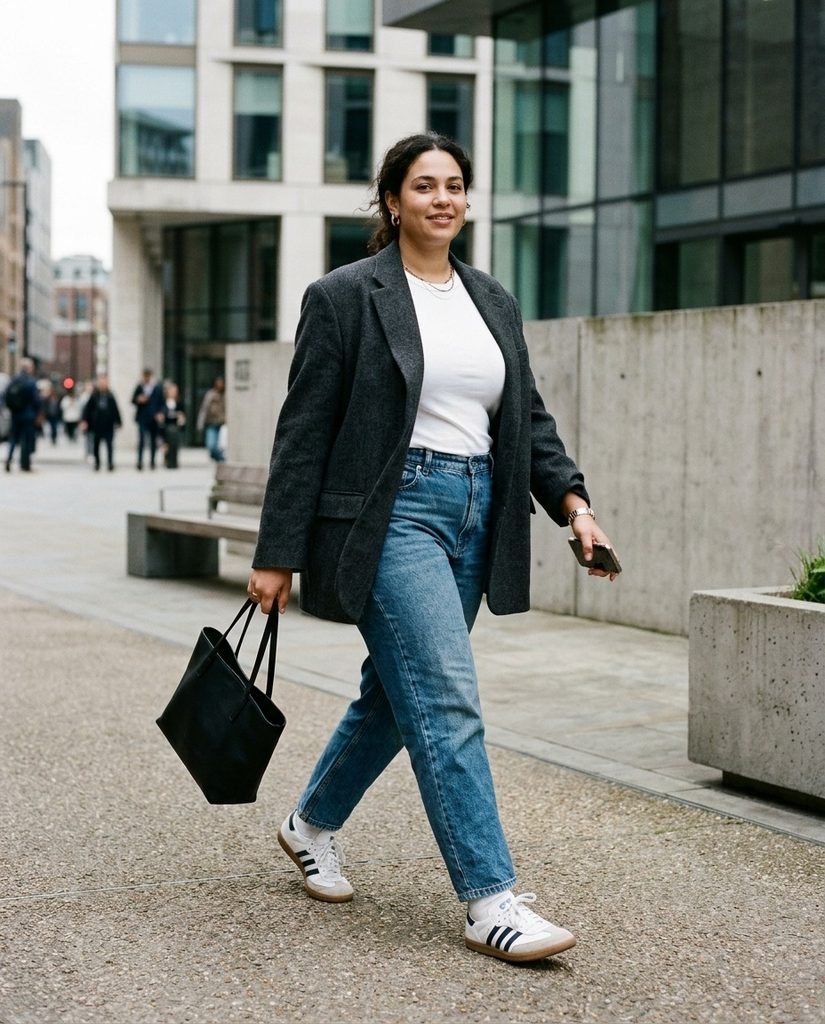
An oversized blazer already brings volume, so a relatively close-fitting inner layer keeps the outfit from feeling bulky from shoulder to ankle.

The jeans don’t need to be skinny. Straight, relaxed, or gently wide-leg denim can all work. The key is creating at least one clean line somewhere—through the fitted tee, visible waist, cropped hem, or streamlined shoe.

If both the jacket and jeans are very wide, a chunky shoe adds even more visual weight. Sometimes that’s exactly the look you want. If it feels overwhelming, try a lower-profile sneaker or expose a little more ankle.

4. Gray blazer + striped tee + blue jeans + black flats

A striped tee introduces pattern without making the outfit complicated.

This combination is particularly useful when plain basics feel flat but you don’t want a statement blazer. The gray jacket and denim behave almost like neutrals, leaving the stripes to create movement.

A crossbody bag keeps the mood casual. A structured top-handle bag would push the same clothes a little dressier.

5. Black blazer + graphic tee + faded jeans + sneakers

A black blazer can easily become formal, so stronger casual contrast helps.

A graphic tee and washed denim break up the severity of the black jacket. Keep the graphic relatively simple if you’d like the outfit to feel grown-up rather than busy.

For dinner, switch sneakers for a low boot or sleek flat. For daytime, keep the sneakers and add a practical tote.

6. Linen blazer + tank + loose trousers + flat sandals

Warm-weather tailoring works best when the entire outfit acknowledges the temperature.

A relaxed linen blazer over a tank creates shape without requiring several layers. Loose trousers continue the movement, while flat sandals stop the combination from looking like a summer suit.

There’s one catch: if the blazer and pants are nearly identical in color, weave, and finish, they may visually reconnect as suit separates. That can look great, but if your goal is casual, create separation with contrasting footwear, an obvious cotton tank, or a different trouser texture.

7. Cropped blazer + simple top + high-rise wide-leg jeans + flats

A shorter jacket changes the proportion rather than simply making the outfit “more fashionable.”

Because the hem ends higher, more of the trouser rise and leg line remain visible. That can be useful with fuller jeans that might otherwise compete with a long blazer.

If you don’t enjoy cropped silhouettes, use a regular hip-length jacket and choose straight-leg denim instead. There is no universal correct proportion; the goal is visual coherence and comfort.

8. Blazer + simple midi dress + sneakers

A blazer can make a casual dress more useful when the weather cools or the occasion calls for a little more structure.

The important distinction is footwear. Sneakers or flat sandals keep the outfit grounded in daytime territory. Pumps and a formal bag can quickly turn the same dress-and-blazer pairing into occasion dressing.

A blazer that ends well above or below the widest part of the skirt often creates a cleaner visual break than one ending at exactly the same point.

9. Brown blazer + cream knit + dark denim + ankle boots

This is an easy fall formula because the tonal temperature is consistent: brown, cream, and deep denim feel visually connected without matching.

Use a relatively fine knit rather than forcing a chunky sweater into a close-fitting blazer. If the sleeves, upper back, or lapels pull once the knit is underneath, the jacket simply doesn’t have enough room for that layer.

10. Blazer + T-shirt + relaxed trousers + sneakers

Jeans aren’t required.

Relaxed trousers work when you want the comfort of a loose pant without denim. Choose a T-shirt rather than a crisp button-down and sneakers rather than formal footwear if you want to keep the combination clearly casual.

If the blazer and trousers are both generously cut, consider tucking or partially tucking the tee. That gives the eye a point of structure between two larger silhouettes.

Which Blazer Works Best With Which Outfit?
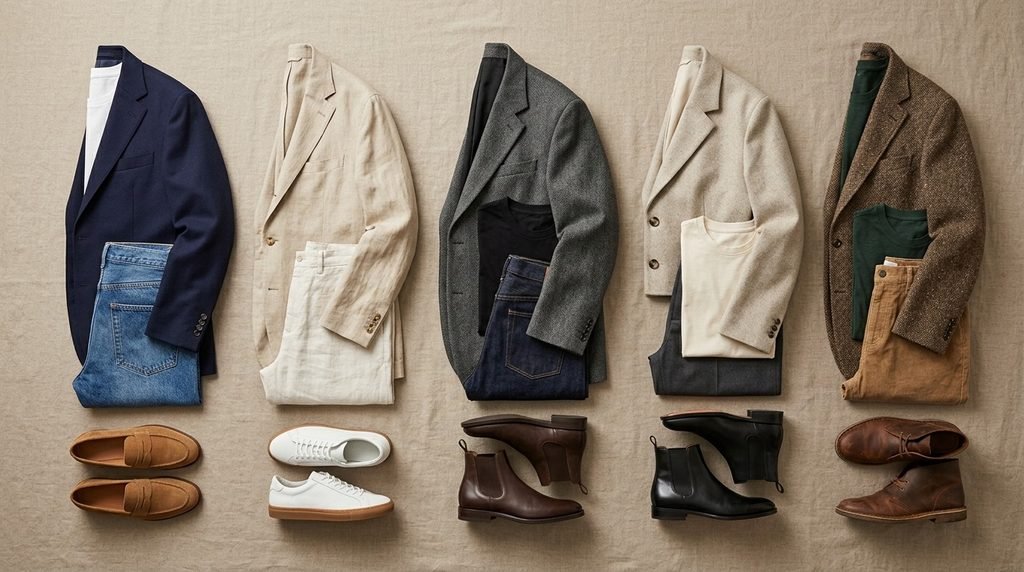
Blazer StyleBest PairingShoe DirectionUseful ForOverall Feel
Soft navy single-breasted blazerTee + straight jeansSneakers or loafersEveryday wear, casual dinnersClassic but relaxed
Linen or linen-blend blazerTank + loose trousersSandals or minimal sneakersWarm weather, vacationsLight and informal
Oversized blazerFitted tee + straight/relaxed denimSlim sneaker, loafer, bootWeekends, city outfitsModern and roomy
Cropped blazerHigh-rise wide-leg jeans or skirtFlats or sneakersCasual dinners, social plansDefined proportions
Structured black blazerGraphic/plain tee + washed denimSneakers or ankle bootsDay-to-night outfitsSharper contrast
Textured wool blazerFine knit + dark denimLoafers or bootsFall and mild winterWarm and polished

The table isn’t a set of rules. Think of it as a starting point: the more structure the blazer contributes, the more you can deliberately relax the rest of the outfit.

How Should You Balance Blazer and Pant Proportions?
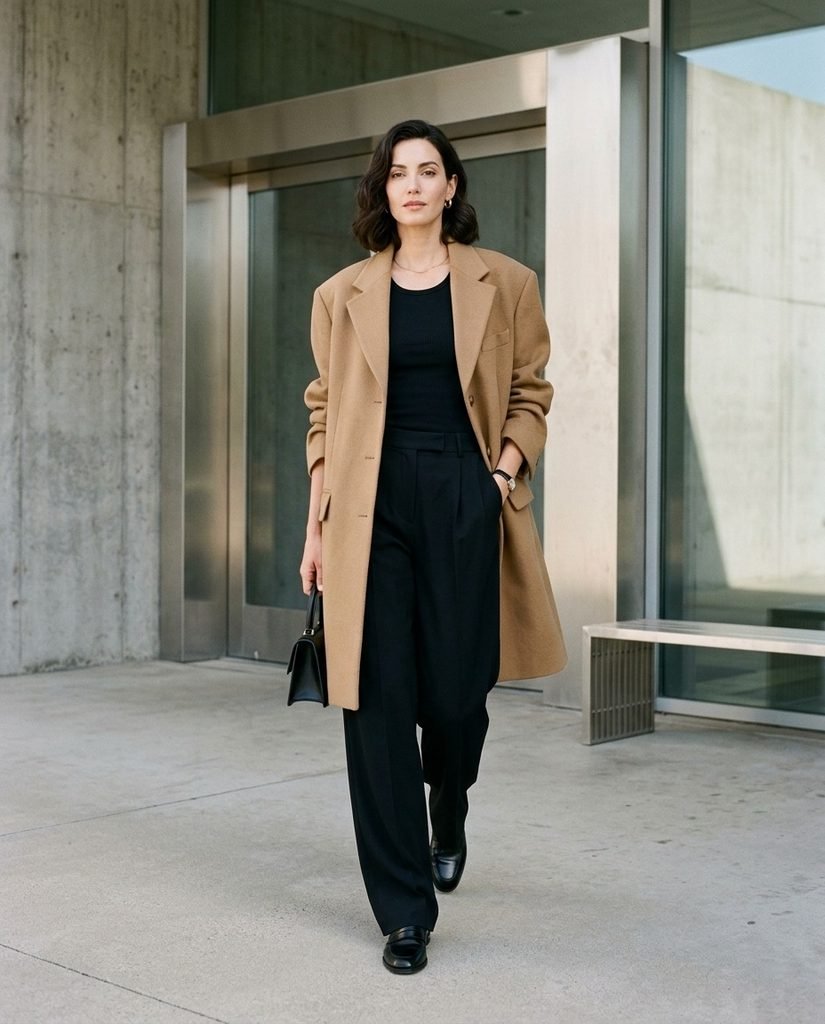
Proportion is less about hiding or “correcting” a body and more about deciding where you want visual volume.

A long oversized blazer with very wide pants creates a large uninterrupted silhouette. That can be dramatic and intentional. If you’re after something quieter, introduce definition elsewhere: choose a closer-fitting top, show the waistband, shorten the trouser break, or use a shoe with a cleaner shape.

A cropped or waist-length jacket does almost the opposite. More of the pants are visible, so the rise and waistband become important parts of the outfit.

High-rise pants plus a short blazer can emphasize the vertical length of the leg. A longer blazer over lower-rise relaxed jeans creates a slouchier line.

Pay attention to the hem, too. Trousers pooling heavily over sneakers have a very different mood from trousers that barely skim the shoe. Neither is automatically wrong—the question is whether the break looks intentional.

What if the blazer and pants are both loose?

They can absolutely work together. Give the eye one point of definition.

That might be a fitted tank, a tucked tee, a visible belt, a cropped inner layer, or a streamlined shoe. You don’t have to make one garment tight simply because another is loose.

Can You Wear Sneakers With a Casual Blazer?
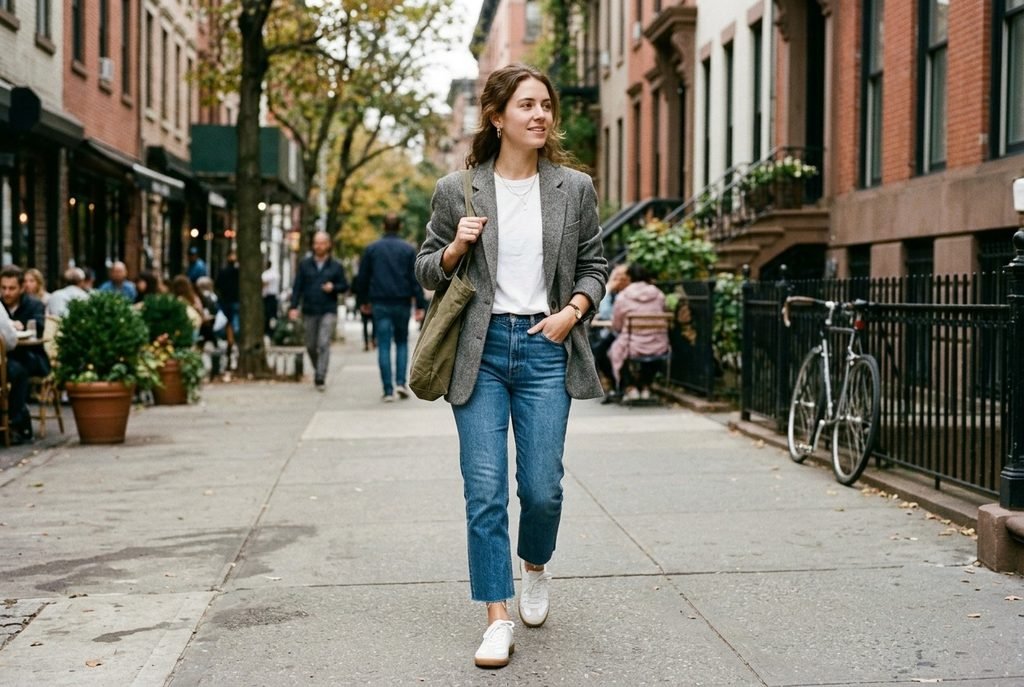
Yes. Sneakers are one of the simplest ways to reduce the formality of a blazer because the shoe changes the context of the entire outfit.

Clean, low-profile sneakers are the easiest starting point because they don’t fight with tailored lines. Chunkier athletic shoes can also work, especially with oversized blazers and wider pants, but they create a more deliberately exaggerated silhouette.

Think about the bottom half as a unit. Straight jeans and minimal sneakers are quiet. Wide pants and chunky sneakers create more volume. A blazer has to visually coexist with that choice rather than “fix” it.

What About Loafers, Flats, and Boots?

Loafers make a casual blazer outfit sharper without automatically turning it into workwear. They pair especially well with straight jeans, ankle-length trousers, and simple tees.

Ballet flats or other streamlined flats create a softer bottom line and work well with cropped jeans, skirts, and dresses.

Ankle boots add more visual weight, which can be useful in fall and winter when the jacket and clothing fabrics are heavier.

Dressier pumps can certainly work, but once you combine them with a structured blazer, tailored pants, and formal accessories, you may have crossed from casual into dressy territory. That’s fine if the occasion calls for it.

How Do You Wear a Blazer Casually in Different Seasons?
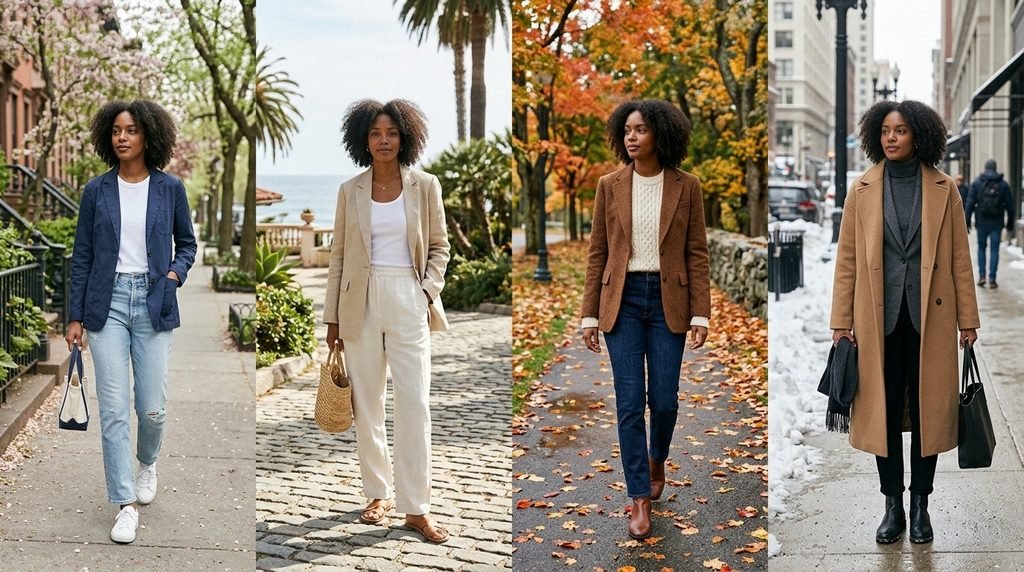
The formula stays largely the same; fabric weight and layer thickness change.

Spring

Try a lightweight blazer with a cotton tee, straight jeans, and sneakers. Cream, navy, gray, soft brown, and muted color all transition easily between cool mornings and warmer afternoons.

Summer

Prioritize breathing room: relaxed construction, an uncomplicated tank or tee, loose trousers, dresses, or shorts where appropriate.

Linen’s visible texture can also make tailoring appear less pristine and therefore more relaxed.

Fall

This is prime layering territory. Add fine-gauge knits, darker denim, loafers, or ankle boots.

A wool or wool-blend blazer can be useful in cooler weather; wool fibers can manage moisture vapor and trap insulating air within their structure, although comfort ultimately depends on the specific garment construction, weight, lining, and climate. Woolmark’s explanation of wool breathability and insulation

Winter

In genuinely cold US climates, think of the blazer as an indoor or middle layer rather than your only outerwear.

Wear a fine knit underneath, then add a sufficiently roomy coat over the blazer. Thick sweaters can work, but only if the blazer has enough space through the armhole, shoulders, sleeves, and back.

Can a Casual Blazer Work for Business Casual?

Often, yes—but “business casual” is not a universal American dress code. Workplace expectations vary considerably by employer, role, city, industry, and event.

If jeans are allowed, a blazer with dark straight denim, a simple knit, and loafers may sit comfortably inside the dress code. If denim isn’t appropriate, substitute chinos, ankle trousers, or another non-matching tailored pant.

The key distinction is casual versus careless. Distressed denim, graphic tees, athletic sneakers, shorts, or oversized silhouettes may be completely appropriate in one workplace and out of place in another.

Check the actual policy and observe what people in comparable roles wear rather than assuming one internet definition applies everywhere.

What Should You Look for When Buying a Casual Blazer?
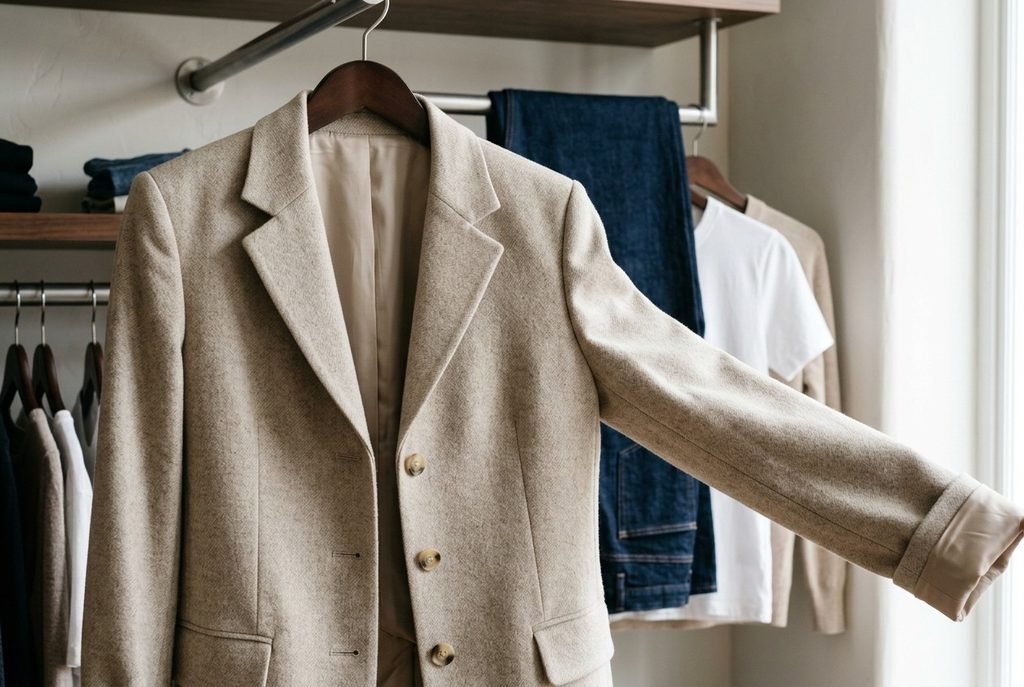
Start with your wardrobe, not the blazer rack.

A jacket is only versatile if it works with clothes you actually own.

Before buying, ask:

  • What will go underneath it? Try the blazer over the tee, knit, or shirt you expect to wear—not only the store’s thinnest camisole.
  • How structured are the shoulders? More padding generally produces a sharper shape; softer construction integrates more easily with relaxed clothes.
  • Where does the hem land? Test it with your most-worn jeans and trousers, especially if they are wide-leg.
  • Does it move? Reach forward, sit down, and cross your arms. Casual clothing isn’t useful if you can’t comfortably move in it.
  • Can the sleeves be adjusted? Sleeve length can change the overall impression more than people expect.
  • Will the color multiply outfits? Navy, gray, camel, brown, cream, and black are all potentially versatile. The best neutral is the one that works with your existing shoes, denim washes, and tops.
  • What does the fabric require? Consider climate, lining, texture, wrinkle tolerance, and how the garment will be cleaned.
  • Does the cost make sense per actual wear? A less expensive blazer you use constantly can be a better wardrobe decision than a premium jacket that only works with one pair of pants.

For US shoppers, the care label is worth checking before purchase. The Federal Trade Commission’s Care Labeling Rule requires covered textile apparel manufacturers and importers to provide regular care instructions, so a label can tell you whether the blazer fits your willingness to hand wash, machine wash, or pay for professional cleaning. FTC Care Labeling Rule

Fiber content matters as well, particularly when you’re comparing two jackets that look similar online. US textile labeling law generally requires covered textile products to identify constituent fibers and their percentages under applicable rules. FTC Textile Products Identification Act

Common Reasons a Casual Blazer Outfit Feels “Off”
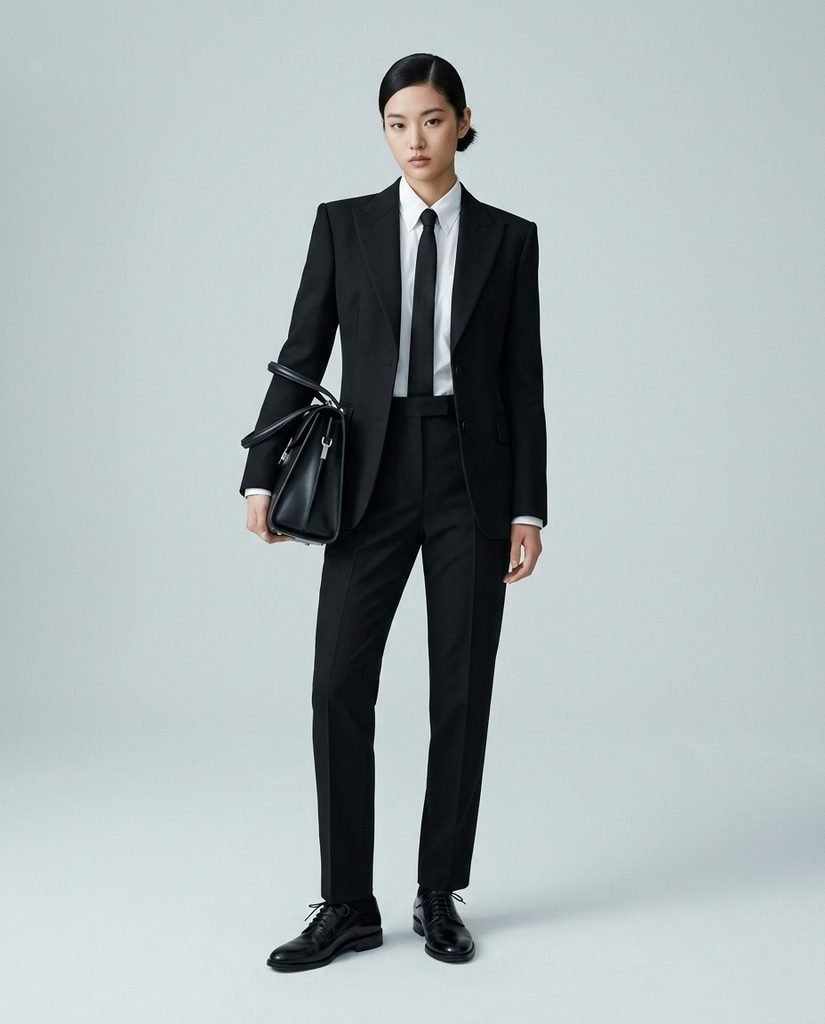
Sometimes the problem isn’t the blazer. It’s that every choice is pushing in the same direction.

Everything is formal. A tailored jacket, crisp blouse, pressed trousers, formal handbag, and polished dress shoes create a coherent look—but it probably isn’t casual. Relax one or two elements.

Everything is oversized. Volume can be stylish, but several large shapes may need a visual anchor such as a fitted inner layer or cleaner shoe.

The layers physically don’t fit. A thick sweater crammed into narrow sleeves creates pulling and bunching. Size the blazer for the layers you actually use.

The blazer looks accidentally separated from a suit. A very smooth jacket worn with nearly matching formal trousers can read as though the original suit pants went missing. Denim, contrasting texture, or clearly different trousers solve that quickly.

The shoes belong to another outfit. Footwear is one of the strongest formality signals. If a jeans-and-tee outfit suddenly feels too dressed up, examine the shoes before changing everything else.

You’re copying a silhouette you don’t enjoy. An oversized blazer isn’t mandatory. Neither are cropped jackets, sneakers, heels, skinny jeans, or wide-leg pants. Style works better when the clothes support how you actually want to move through the day.

Frequently Asked Questions

What do you wear with a blazer casually?

Pair a blazer with visibly relaxed pieces such as jeans, a crewneck T-shirt, tank, fine knit, sneakers, flats, or loose non-matching trousers. You only need a few casual signals to change the mood. If the blazer is highly structured, faded denim and simple footwear usually create more useful contrast than another tailored piece.

Can you wear a blazer with jeans?

Yes. Jeans and a blazer work because denim reduces the formality of tailoring. Straight-leg jeans are an easy starting point, but relaxed, wide-leg, cropped, and slim silhouettes can also work. Choose the jean shape according to the blazer’s length and volume, then use the shoe to decide whether the outfit feels more casual or polished.

What shoes go with a casual blazer?

Sneakers, loafers, flats, sandals, and ankle boots can all work. Sneakers provide the strongest casual signal; loafers make the outfit smarter; flats keep the silhouette clean; and boots add useful visual weight in cooler weather. Choose shoes in relation to the pants rather than treating the blazer as the only styling consideration.

Can you wear sneakers with a blazer?

Absolutely. A blazer with sneakers works particularly well when the rest of the outfit includes casual pieces such as denim, a T-shirt, chinos, or relaxed trousers. Minimal sneakers create the easiest balance. Chunkier sneakers can also work with oversized tailoring or wide pants when you want a more substantial silhouette.

How do you make a blazer look less formal?

Reduce the number of formal elements surrounding it. Swap a blouse for a tee, suit trousers for denim, pumps for sneakers, or a structured work bag for a casual crossbody. Softer shoulders, textured fabrics, rolled or pushed-up sleeves, and non-matching bottoms can also move a blazer away from a corporate appearance.

Should a casual blazer be oversized?

No. Oversized blazers are one option, not a requirement. A regular or slightly relaxed fit can be just as casual when paired with denim, tees, flats, or sneakers. Choose oversized tailoring if you enjoy additional volume and room for layers. If you prefer more definition, a straight or gently shaped blazer may suit your wardrobe better.

What color blazer is the most versatile?

There isn’t one universally best color because versatility depends on the rest of your closet. Navy works easily with denim, cream, gray, and many earth tones; black can move between casual and dressier outfits; gray is especially adaptable; and camel or brown works well with warm neutrals. Check your most-worn pants, tops, and shoes before choosing.

Final Take: Casual Blazer Outfits Are About Contrast

The most convincing Casual Blazer Outfits don’t depend on a secret styling trick. They work because tailored and relaxed elements are deliberately mixed.

Start with what you already own: a blazer, a simple top, your most comfortable jeans or trousers, and shoes that match the level of formality you want. Then pay attention to proportion. A softer shoulder, visible denim texture, practical shoe, or uncomplicated layer can change the entire mood.

A blazer doesn’t have to make you look more dressed up. Sometimes its job is simply to give an ordinary outfit a little more shape.

For more practical outfit-building ideas, keep FashionDew in your rotation as its fashion guide library comes online.


Helena Grace

Helena Grace

Keep in touch with our news & offers

Subscribe to Our Newsletter

Recent Posts

quartz co. teslin recycled down winter jacket
Quartz co. Teslin Recycled Down Winter Jacket Review

A winter coat can look perfectly capable on a hanger and still be wrong for the way you actually spend January. Think about a cold morning commute: wind at the train platform, wet snow on the walk to work, an overheated coffee shop, then another stretch outdoors after dark. The Quartz co. Teslin Recycled Down …

Soia & Kyo Women's Blaire Packable Trench Coat
Soia & Kyo Women’s Blaire Packable Trench Coat Guide

You can love the idea of a trench coat and still leave it at home. A long, structured coat takes up space, becomes another thing to carry through an airport, and may feel excessive once the afternoon turns warmer than the morning. That's the practical problem behind the Soia & Kyo Women's Blaire Packable Trench …

more to come macie maxi dress
More to Come Macie Maxi Dress: Fit, Styling & Buying Guide

The More to Come Macie Maxi Dress is a sheer, unlined knit maxi from contemporary womenswear brand MORE TO COME. Revolve lists it in cream and black, with sizes XXS through XL and a 65% polyester, 35% cotton composition. Its strongest use case is warm-weather, vacation, beach, and intentionally sheer styling—not shoppers seeking a conventional …

Lv Anti-aging Moisturizer: What to Know in 2026 Bottom Line: lv Anti-aging Moisturizer refers to Livinz Medspa's LV Anti-Aging Moisturizer, a $86.99 firming and brightening face moisturizer featuring Lipochroman®, Chromabright®, and unspecified firming peptides. The jar image also mentions a retinoid and identifies the size as 1.7 fl oz/50 mL. The biggest issue isn't the ingredient story—it's transparency. The current listing doesn't provide a complete ingredient list, identify the retinoid, or publish detailed directions, so those details are worth confirming before you buy. Anti-aging moisturizers can make shopping oddly complicated. One jar promises antioxidant protection. Another talks about peptides. A third leans hard on brightening technology. After a while, a bathroom shelf can start to look like a chemistry experiment with nicer packaging. LV Anti-Aging Moisturizer brings several of those ideas into one product. That's interesting. But the useful question isn't whether the ingredient names sound advanced. It's what we can actually verify about the formula, what the evidence says, and whether an $86.99 moisturizer makes sense for your routine. Here's what the available information tells us—and where the blanks still are. What Is lv Anti-aging Moisturizer? lv Anti-aging Moisturizer is the search phrase pointing to LV Anti-Aging Moisturizer, a Livinz Medspa-branded facial moisturizer positioned for firming, brightening, hydration, and the visible signs of aging. Livinz Medspa is a medical-spa business with locations listed in New York and North Carolina and sells an assortment of LV-branded skincare products. The seller's current description highlights three main components: Lipochroman®, promoted for antioxidant activity. Chromabright®, promoted for the appearance of uneven pigmentation. Firming peptides, promoted for fine lines and firmness. Livinz also says the moisturizer hydrates and improves the appearance of lines, wrinkles, and age spots. Those statements should be understood as product marketing claims unless independent testing of the finished formula demonstrates them. There's another wrinkle—figuratively, this time. The current jar image states “Antioxidants and Retinoid,” but the product description doesn't tell shoppers which retinoid is present. That's not a trivial omission. Knowing the actual retinoid matters for sensitivity, routine compatibility, pregnancy precautions, and realistic expectations. lv Anti-aging Moisturizer at a Glance Feature What We Found Why It Matters Product type Firming and brightening antioxidant facial moisturizer It's positioned as a moisturizer with added cosmetic anti-aging benefits rather than a standalone treatment serum. Seller/branding Livinz Medspa / LV-branded skincare The finished-product manufacturer isn't identified on the current listing. Current listed price $86.99 That's premium-moisturizer territory, increasing the importance of formula transparency. Size 1.7 fl oz / 50 mL, shown on the official jar image A common full-size facial moisturizer quantity. Featured ingredients Lipochroman®, Chromabright®, firming peptides Gives the formula an antioxidant + brightening + peptide positioning. Retinoid Official jar image says “Antioxidants and Retinoid”; type/concentration not disclosed in webpage text Retinoid identity can materially affect how and when you use a product. Full ingredient list Not clearly disclosed on the current product page A significant limitation for sensitive skin, allergies, or active-heavy routines. Detailed directions Not clearly disclosed on the current page We shouldn't invent a frequency or application instruction on Livinz's behalf. Stock status Page displays “Sold out” but also a Buy Now control Confirm availability before planning a purchase. Finished-product clinical evidence No peer-reviewed trial specific to LV Anti-Aging Moisturizer was identified in the sources reviewed Ingredient research shouldn't be confused with testing of the complete formula. One small but telling detail deserves attention: the Livinz description refers to “Ultra Benefits®” inside a benefit statement for LV Anti-Aging Moisturizer. That may simply be leftover product copy. It may reflect a formulation relationship. The available evidence doesn't establish which, so the sensible move is to treat it as an unanswered question rather than construct a story around it. What's Inside lv Anti-aging Moisturizer? The verified ingredient story is narrower than the marketing language makes it sound. Livinz specifically identifies Lipochroman®, Chromabright®, and firming peptides. Beyond that, the current webpage doesn't give us a full formula to evaluate. Lipochroman®: an antioxidant with ingredient-level evidence Lipochroman-6 is a trade name associated with dimethylmethoxy chromanol, a synthetic antioxidant molecule structurally related to chroman compounds. PubChem lists LIPOCHROMAN-6 among the synonyms for dimethylmethoxy chromanol. Here's where separating laboratory science from skincare advertising becomes useful. A peer-reviewed study found that dimethylmethoxy chromanol could quench singlet oxygen in solution and reduce singlet-oxygen lifetime and emission in ex-vivo pig skin. That's legitimate evidence of antioxidant activity. It is not, however, a clinical trial demonstrating that LV Anti-Aging Moisturizer removes wrinkles or prevents photoaging in people. Livinz goes further in its product copy, describing Lipochroman as the “strongest antioxidant” and connecting it with protection from UV and pollutants. Those stronger superiority and outcome claims come from the seller and shouldn't be converted into independent facts without comparative clinical evidence for the marketed formula. Editorial read: Lipochroman makes the formula more interesting on paper, especially if you're interested in antioxidant skincare. But antioxidant test-tube performance isn't a substitute for knowing its concentration, vehicle, stability, or clinical performance inside this particular jar. Chromabright®: promising for tone, with important evidence limits Chromabright is associated with dimethylmethoxy chromanyl palmitate. PubChem lists “CHROMABRIGHT” as a synonym for that ingredient. Livinz says Chromabright decreases the appearance of uneven pigment and age spots and claims it is 50% more effective at skin brightening than kojic acid. It also attributes UVA, UVB, and HEV protection to the ingredient. Those are seller claims. There is some outside evidence behind the brightening concept. A scientific review of skin-lightening agents noted an in-vivo study in 20 Asian volunteers in which dimethylmethoxy chromanyl palmitate showed a brightening effect after 30 and 60 days. Still, that's a small ingredient study, not a controlled trial of LV Anti-Aging Moisturizer in a representative US consumer population. So the reasonable conclusion is more modest: Chromabright has an evidence-backed rationale as a cosmetic brightening ingredient, but we can't use that evidence to predict the magnitude of results from the finished LV product. Firming peptides: the exact peptide matters Livinz highlights “firming peptides” but doesn't identify those peptides in the current product description. Peptide skincare isn't automatically snake oil, nor is every peptide formula interchangeable. A 2026 systematic review and meta-analysis covering 19 randomized trials and 1,341 participants found improvements across some skin-aging outcomes, although the wrinkle effect was modest and much of that signal was driven by oral rather than topical polypeptides. The authors also called for larger, standardized trials. Earlier dermatology literature makes another practical point: for a topical peptide to matter clinically, the finished product needs to keep it stable, deliver it through the skin appropriately, and maintain biological activity. That's why “contains peptides” isn't enough information to judge an $86.99 cream. What about the retinoid on the jar? Here's where things get especially interesting. The official Livinz product photograph visibly says “Antioxidants and Retinoid.” Yet the current webpage's ingredient section doesn't name any retinoid at all. Retinoids are vitamin A derivatives, and some have substantially stronger evidence for visible photoaging than many cosmetic anti-aging ingredients. The American Academy of Dermatology notes that retinoids can help with mild fine lines, uneven pigmentation, and texture, but they can also irritate dry or sensitive skin. AAD also advises that retinoids should not be used during pregnancy. That makes the missing detail especially important. Before purchasing, ask Livinz: Which retinoid is in the current formula? What is its concentration? Is the photographed jar the current formulation? Is the moisturizer intended for morning use, evening use, or both? Has the formulation changed since the current photo was produced? Until those questions are answered, it would be premature to build an elaborate retinoid routine around this product. Other ingredients worth noticing—or rather, verifying A complete ingredient list is one of the most useful pieces of information a skincare shopper can have. It can reveal humectants, emollients, fragrance ingredients, botanical oils, preservatives, known allergens, additional actives, and ingredients that may overlap with the rest of your routine. That full list isn't present in the LV product-page text we reviewed. For someone with uncomplicated skin, that may be an annoyance. For someone who needs to avoid specific ingredients, it's a much bigger deal. What Benefits Can You Realistically Expect? The most realistic expectation is moisturized skin with possible improvements in the appearance of fine lines, brightness, and uneven-looking tone—not guaranteed wrinkle removal, lifting, or reversal of skin aging. It's useful to break the claims apart. Hydration Livinz says the moisturizer hydrates. That's entirely plausible for the product category, although the missing full INCI means we can't independently assess its moisturizing system. Moisturizers can make fine lines look softer because increasing skin hydration temporarily plumps the surface. The American Academy of Dermatology specifically notes that moisturizer can reduce the appearance of some fine lines and make the complexion look brighter. That isn't the same as permanently restructuring a wrinkle. Fine lines and wrinkles Livinz markets peptides and other ingredients for the appearance of fine lines and wrinkles. Ingredient science makes that plausible as a cosmetic goal, but there's no verified finished-product trial here establishing how much improvement to expect. If the product truly contains an effective retinoid at an appropriate concentration, that could materially strengthen the anti-aging case. But we don't know which retinoid the current jar contains. So “may improve the appearance of fine lines” is defensible. “Reverses wrinkles” is not a conclusion the available evidence supports. Firmness Firming creams deserve especially realistic expectations. AAD notes that results from skin-firming creams tend to be subtle at best and that a cream cannot literally lift sagging skin the way a procedure might. Some immediate “firming” effects can simply come from moisturized skin appearing temporarily plumper. That's a useful reality check for this product's peptide positioning. Brightness and uneven-looking tone Chromabright gives this formula a more specific brightening story than a basic moisturizer. The available ingredient research suggests a plausible effect on the appearance of pigmentation, but the small human evidence base and absence of an LV-specific trial mean expectations should stay moderate. If you're dealing with persistent or changing pigmentation rather than routine cosmetic dullness, that's also a different conversation from simply choosing a moisturizer. Antioxidant support Lipochroman's antioxidant activity has legitimate laboratory support. What isn't established is exactly how much antioxidant benefit the finished moisturizer delivers on human skin under everyday conditions. Concentration, formulation, packaging, stability, and application all matter. Ingredient buzzwords can't answer those questions by themselves. What about the UV-protection claims? Do not treat LV Anti-Aging Moisturizer as your sunscreen based on the ingredient claims currently published. Livinz attributes UV-related protective benefits to Lipochroman and Chromabright, but the product page does not present LV Anti-Aging Moisturizer as a conventional broad-spectrum SPF product with an SPF value. FDA distinguishes ordinary cosmetic claims from sunscreen/drug claims, and US sunscreens are subject to specific labeling and testing requirements. AAD recommends a broad-spectrum, water-resistant SPF 30 or higher as part of an anti-aging routine. In everyday terms: antioxidants can complement sunscreen. They don't replace it. Who Might Like lv Anti-aging Moisturizer? This product may make sense for shoppers who: Want one moisturizer with antioxidant, brightening, and peptide positioning rather than a bare-bones hydration formula. Are primarily concerned with the cosmetic appearance of dryness, mild fine lines, dullness, or uneven-looking tone. Already understand that daily sunscreen remains essential. Don't mind paying a premium if the ingredient story and eventual full formula meet their needs. Are willing to contact the seller and verify the missing INCI and retinoid details before committing. Prefer a moisturizer-based anti-aging step rather than adding multiple separate serums. The key phrase is may make sense. Without a full formula and confirmed retinoid identity, there isn't enough information to confidently match this product to every skin type. Who Should Think Twice? A few shoppers have good reasons to slow down before ordering. You're sensitive to active ingredients The jar's retinoid statement matters. Retinoids can irritate skin, particularly when you're starting out or when they're combined too aggressively with other active products. If your skin is easily irritated, don't assume the formula will be gentle simply because it is sold as a moisturizer. You need to avoid specific allergens or fragrance The current Livinz listing doesn't give us a full INCI list. That means a shopper who needs to avoid a particular preservative, botanical, fragrance ingredient, or other sensitizer can't make an informed decision from the page alone. Ask for the current packaging ingredient list, not merely a summary of featured ingredients. You're pregnant Because the current jar image mentions a retinoid, this is a product to verify before use during pregnancy. The AAD advises against retinoid use during pregnancy. You expect a cream to lift sagging skin That's beyond what a cosmetic moisturizer should realistically promise. Topical firming products may subtly improve appearance, but AAD notes that creams cannot truly lift sagging skin. You want maximum ingredient transparency for your money At $86.99, wanting the full ingredient list, current formula, intended frequency, and active details isn't nitpicking. It's reasonable shopping due diligence. You need treatment for a persistent skin problem Cosmetic moisturizers and medically directed treatment aren't interchangeable. FDA notes that products making claims about changing skin structure or function cross into drug territory rather than ordinary cosmetic claims. For a concern that isn't improving with routine skincare, a dermatologist can help identify what type of intervention actually fits. How to Use It in a Skincare Routine The Livinz product page reviewed doesn't provide clear manufacturer-specific application directions, so it would be misleading to invent an official twice-daily schedule. What we can give you is a sensible category-level routine position for a facial moisturizer. Cleanse. Use a gentle cleanser appropriate for your skin. Apply any compatible treatment or serum. This could be a simple hydrating serum or another established treatment in your routine. Apply your moisturizer. This is where LV Anti-Aging Moisturizer would normally fit. In the daytime, finish with broad-spectrum SPF 30 or higher. Don't count the moisturizer's antioxidant or “UV protection” ingredient language as sunscreen. There's an extra caveat here: verify the retinoid first. If Livinz confirms that the current moisturizer contains a retinoid, its identity and strength should guide how you introduce it. AAD generally advises starting retinoids slowly, paying attention to dryness and irritation, and using sun protection during the day. If you're already using retinol, prescription tretinoin, strong exfoliating acids, or other potentially irritating products, knowing what's actually inside this moisturizer becomes even more important. Is lv Anti-aging Moisturizer Worth the Price? It depends on how much you value the ingredient concept versus formula transparency. The $86.99 price and 50 mL jar work out to roughly $1.74 per mL, placing the moisturizer well above basic drugstore pricing. On paper, there are reasons to be interested: Lipochroman has genuine antioxidant research behind its ingredient. Chromabright has at least some human brightening evidence. Peptides can be useful in well-designed topical formulas. A genuine retinoid could add a more evidence-backed anti-aging component. But premium skincare should be judged on more than an attractive active-ingredient headline. At this price, we'd want to know: The complete current INCI list. The exact retinoid. Active concentrations where the brand is willing to disclose them. Whether the photographed packaging reflects the current formula. Recommended frequency. Compatibility guidance. Product-specific human testing, if any exists. That's the trade-off. The formulation concept looks more interesting than a generic moisturizer, but the current disclosure doesn't make it easy to judge whether it earns its premium price. And no, a higher price alone isn't evidence of a better formulation. What Makes FashionDew's Approach Useful? For this article, FashionDew's useful role is editorial rather than experiential. This is not being presented as a hands-on product review, and no first-hand testing has been invented. Instead, the analysis separates four things that skincare pages too often blur together: What the seller says. Livinz makes specific claims about firming, brightening, antioxidants, peptides, and visible aging. What independent research supports. Some featured ingredient concepts have scientific support, but the strength and relevance of that evidence varies. What we still don't know. The complete formula, retinoid identity, directions, manufacturer, concentrations, and finished-product clinical evidence remain unclear. What that means when you're spending your own money. Instead of asking whether an ingredient sounds impressive, ask whether the product provides enough information to judge compatibility, evidence, and value. That's a much more useful standard than simply counting trendy actives on the front of a jar. Questions to Ask Before Buying Before you add LV Anti-Aging Moisturizer to your cart, consider asking: Can Livinz provide the complete current INCI ingredient list? Which retinoid is referenced on the jar? What concentration of that retinoid is used? Is the product intended for morning, evening, or twice-daily application? Is the 1.7 fl oz/50 mL jar shown online the current formulation and packaging? Does the formula contain fragrance, essential oils, or ingredients you personally avoid? Are there any compatibility recommendations for people already using retinol, prescription retinoids, exfoliating acids, or benzoyl peroxide? Has the finished LV moisturizer, rather than just its individual ingredients, undergone controlled human testing? What explains the “Ultra Benefits®” wording on the LV product page? Is the item currently in stock, given the conflicting “Sold out” and “Buy Now” signals on the listing? If UV protection is being claimed, what tested SPF or regulated sunscreen labeling supports that claim? Those answers would tell you considerably more than another paragraph about “youthful-looking skin.” lv Anti-aging Moisturizer FAQs What does lv Anti-aging Moisturizer do? LV Anti-Aging Moisturizer is marketed by Livinz Medspa to hydrate, brighten, firm, and improve the appearance of fine lines, wrinkles, and uneven-looking pigmentation. Its highlighted ingredients are Lipochroman®, Chromabright®, and firming peptides. Those benefits are seller claims; independent clinical results for the finished LV moisturizer weren't identified in the research reviewed. Is lv Anti-aging Moisturizer good for mature skin? Potentially, but “mature skin” alone isn't enough to determine fit. Its hydration, antioxidant, brightening, peptide, and possible retinoid positioning is relevant to concerns that often accompany visible skin aging. The bigger issue is that the current product page doesn't disclose the complete formula or clearly identify the retinoid, making sensitivity and compatibility harder to assess. Can I use lv Anti-aging Moisturizer every day? The current Livinz product page reviewed doesn't clearly publish an official application frequency, so we can't responsibly state that the manufacturer instructs daily or twice-daily use. The jar's retinoid wording is another reason to verify directions with Livinz first, particularly if you already use other active skincare products. Does lv Anti-aging Moisturizer help wrinkles? It may help the appearance of fine lines, but guaranteed wrinkle removal isn't supported. Moisturization alone can temporarily make fine lines less noticeable, while peptides and retinoids can have additional benefits depending on the specific ingredient, concentration, stability, and formulation. The finished LV product doesn't currently have independently verified wrinkle-treatment results in the sources reviewed. Does lv Anti-aging Moisturizer contain retinol? We can't verify that it contains retinol specifically. The official jar image says “Antioxidants and Retinoid,” but Livinz's current web description does not identify the retinoid. “Retinoid” is a broader category than “retinol,” so those terms shouldn't be treated as interchangeable here. Should I still use sunscreen with it? Yes. Don't substitute this moisturizer for a dedicated sunscreen based on antioxidant or UV-related ingredient claims. For daily anti-aging sun protection, the American Academy of Dermatology recommends broad-spectrum, water-resistant sunscreen with SPF 30 or higher. Is LV Anti-Aging Moisturizer the same as Ultra Benefits? That cannot be verified from the available evidence. The Livinz product page unexpectedly uses the name “Ultra Benefits®” in one benefit statement, and other products on the market use similar Lipochroman/Chromabright/peptide positioning. But similar copy does not prove that the formulas, manufacturers, or products are identical. Ask Livinz directly if that distinction matters to your purchase. Is lv Anti-aging Moisturizer worth $86.99? It may be worth considering if you specifically want its antioxidant-and-brightening concept and the seller can provide satisfactory answers about the full formula and retinoid. At this price, though, the current lack of complete ingredient and usage disclosure is a meaningful drawback. A premium price doesn't automatically mean stronger clinical evidence or better results. Final Verdict lv Anti-aging Moisturizer has an intriguing ingredient story, but the unanswered formula questions matter almost as much as the featured actives. Lipochroman provides a legitimate antioxidant rationale. Chromabright has some ingredient-level brightening evidence. Peptides can contribute to a well-designed anti-aging formula. And the retinoid statement on the jar could be significant. The problem is that shoppers currently have to piece too much of that story together themselves. The complete ingredient list isn't clearly published. The retinoid isn't identified. Detailed instructions are missing from the page. The seller makes substantial claims around UV protection without presenting the moisturizer as a standard SPF product. And the product copy contains an unexplained “Ultra Benefits®” reference. For an $86.99 moisturizer, those aren't insignificant details. If Livinz provides a current INCI list and clarifies the retinoid and usage instructions, you'll be in a much better position to decide whether the formula deserves a place in your routine. Until then, the most defensible verdict is promising ingredient concept, incomplete purchasing information. Explore more FashionDew beauty and style guides as the site's editorial library grows for straightforward, evidence-aware breakdowns designed to make product research easier.
Lv Anti-aging Moisturizer: What to Know in 2026

lv Anti-aging Moisturizer refers to Livinz Medspa's LV Anti-Aging Moisturizer, a $86.99 firming and brightening face moisturizer featuring Lipochroman®, Chromabright®, and unspecified firming peptides. The jar image also mentions a retinoid and identifies the size as 1.7 fl oz/50 mL. The biggest issue isn't the ingredient story—it's transparency. The current listing doesn't provide a complete …

Comments

Leave a Reply

Your email address will not be published. Required fields are marked *