
Women’s Stretch Wrinkle Free Machine Washable Blaze: A Practical Guide

It’s 7:40 on a weekday morning. You have a meeting on the calendar, coffee in one hand, and a blazer that somehow looks more rumpled than it did when you hung it up. There isn’t time for ironing, and the thought of another dry-cleaning errand isn’t especially appealing.

That everyday problem explains the interest behind searches for Women’s Stretch Wrinkle Free Machine Washable Blaze. Most shoppers aren’t simply looking for a jacket that looks professional. They want something that can move through a normal day—commuting, sitting, typing, traveling, going to dinner—and still be relatively easy to care for.

The trick is knowing which features actually make a blazer practical and which product descriptions deserve a closer look.

Bottom Line

A women’s stretch, wrinkle-resistant, machine-washable blazer can be useful because it combines professional structure with easier movement and lower-maintenance care. The strongest options fit comfortably through the shoulders and armholes, recover well after stretching, resist everyday creasing, and include care instructions that work with your routine. “Machine washable” and “wrinkle-free,” however, should always be verified against the individual garment’s specifications and care label.

Why Easy-Care Blazers Fit Modern Wardrobes

A blazer has traditionally been one of the easiest ways to make an outfit look intentional. What has changed is what many women expect that blazer to do.

For everyday wear, a jacket may need to survive a car commute, several hours at a desk, a lunch meeting and an evening stop without demanding a wardrobe change. That puts comfort and maintenance much closer to the top of the buying checklist.

Easy-care construction can be particularly useful when you wear tailored clothing often. Instead of thinking only about how a blazer photographs while standing, consider how it behaves during the less glamorous 90% of the day.

Stretch and Everyday Movement

Stretch matters most when the blazer is doing something other than hanging neatly on your shoulders.

A blazer that fits while you’re standing may feel completely different once you reach forward to type, hold a steering wheel or lift your arms. Tight armholes, a rigid upper back or fabric that pulls across the shoulders can turn a seemingly correct size into an uncomfortable all-day choice.

Look beyond the presence of stretch fiber alone. Fabric recovery—how well the material returns toward its original shape after being stretched—also matters. A comfortable blazer shouldn’t immediately feel baggy at the elbows or lose its intended shape simply because you’ve spent several hours sitting.

Construction plays a role, too. Stretch in the outer fabric is less useful if a rigid lining restricts movement inside the jacket. For shoppers who spend long periods at a desk, the relationship between shell fabric, lining and armhole construction can matter as much as the fiber percentages listed on the tag.

Wrinkle Resistance and a Polished Look

“Wrinkle-resistant” and “wrinkle-free” are not necessarily interchangeable promises.

Wrinkle resistance generally describes a fabric or garment that is less prone to visible creasing under normal wear. “Wrinkle-free” sounds more absolute, but real-world performance can still vary according to fabric, construction, packing pressure, moisture, heat and how long the garment stays folded.

For commuters, the practical question is usually not, “Will this blazer literally never wrinkle?” A more useful question is, “Will it still look presentable after sitting in a car or at a desk?”

Travelers may have a tougher test. A jacket compressed under shoes and toiletries for eight hours faces very different conditions from one worn on a 30-minute commute. If packability is important, check product-specific information rather than relying on a wrinkle-related phrase alone.

Machine Washability and Maintenance

Machine washability can remove one of the biggest inconveniences associated with traditional tailoring: routine trips to the dry cleaner. But the phrase doesn’t mean you can automatically use any cycle, water temperature or dryer setting.

In the United States, the Federal Trade Commission’s Care Labeling Rule requires covered manufacturers and importers to provide regular care instructions for textile apparel. Washing instructions can address washing method, drying, ironing, bleaching and necessary warnings.

The useful takeaway for shoppers is simple: the actual care label outranks assumptions based on the words “machine washable.” The FTC’s Clothes Captioning care-labeling guide is a helpful reference, while the underlying requirements are available in 16 CFR Part 423.

What to Look for Before Choosing a Women’s Blazer
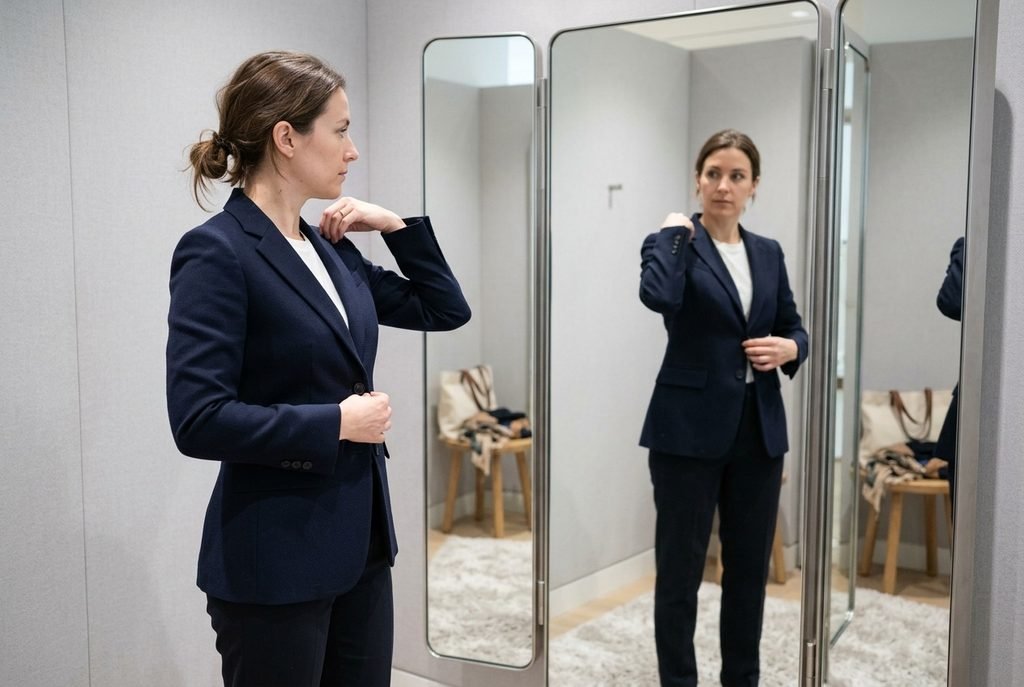
The best blazer for you depends on how and where you’ll wear it. Before buying, compare the details that affect real-life comfort and maintenance rather than focusing on the front-view silhouette alone.

Buying factorWhat to checkWhy it matters
Shoulder fitSeam placement, pulling or collapsingThe shoulders establish much of the jacket’s overall fit
Arm mobilityReach forward, raise your arms and bend your elbowsReveals restrictions that aren’t obvious while standing
StretchFiber composition and how the fabric feels in motionInfluences comfort during sitting, driving and working
RecoveryWhether stretched areas return toward their original shapeHelps prevent a tired or bagged-out appearance
LiningFull, partial, stretch or unlined constructionCan affect mobility, breathability and care
ClosureButton placement and pulling across the frontShows whether the torso has adequate room
LengthWhere the hem falls on your bodyChanges proportions and outfit versatility
PocketsReal vs. decorative; placement and bulkUseful pockets can matter in work and travel wardrobes
CareComplete product and label instructionsDetermines how practical the blazer really is
Wrinkle performanceProduct-specific claims and fabric behaviorEspecially relevant for commuting and packing
Layering roomFit over your usual blouse, knit or teePrevents buying a blazer that works only with one outfit
SeasonalityFabric weight, lining and breathabilityHelps determine how many months you’ll actually wear it

If you arrived through the search phrase Women’s Stretch Wrinkle Free Machine Washable Blaze, these are the details worth translating that phrase into before purchasing.

Stretch vs. Traditional Blazers
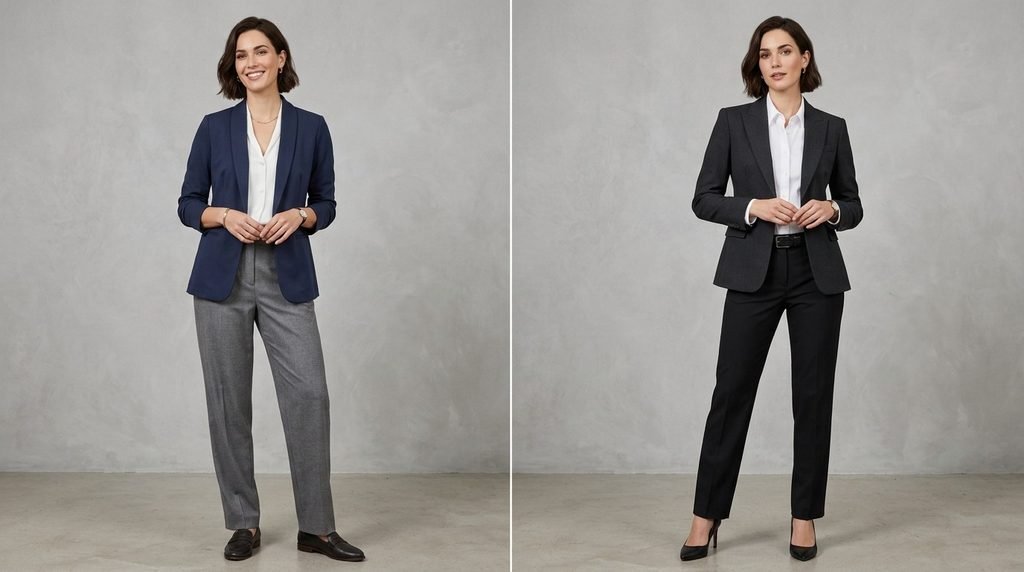
Neither construction is automatically better. The right choice depends on whether you prioritize movement and low-maintenance care or sharper traditional tailoring.

FeatureStretch/Easy-Care BlazerTraditional Tailored BlazerWhy It Matters
MovementOften designed to allow more giveMay feel more structured or rigidImportant for desk work, commuting and travel
AppearanceCan range from soft tailoring to structuredOften emphasizes crisp shapingDress codes may favor different levels of structure
CareSome styles are washableDry cleaning may be more commonChanges ongoing time and maintenance requirements
PackabilityMay recover more easily from everyday creasingStructured construction can require careful packingRelevant for frequent travelers
LayeringFlexible fabrics can feel forgivingPrecise tailoring may require more exact sizingMatters with sweaters and long-sleeve tops
FormalityExcellent for many business-casual settingsOften preferred for highly formal tailoringYour workplace or event determines the better choice
Longevity of shapeDepends heavily on fabric recovery and constructionStructured elements can hold a defined silhouetteQuality cannot be judged from “stretch” alone

A stretch blazer may be more practical for a long workday when mobility and easy garment care matter more than rigid tailoring. A traditional blazer may still make more sense when you want pronounced structure, formal suiting or a fabric that isn’t intended to prioritize wash-at-home convenience.

How Should a Women’s Blazer Fit?

A women’s blazer should sit cleanly across the shoulders, provide enough room through the bust and upper back, and let you move your arms without significant pulling. Buttoning the jacket shouldn’t create strong horizontal strain lines, and the blazer should remain comfortable when you sit rather than fitting only in a standing pose.

Start at the shoulders because that area is difficult to disguise. The shoulder seam should generally align naturally with the intended edge of the shoulder unless the style is deliberately oversized or dropped.

Then check the front. Lapels should lie relatively flat rather than bowing dramatically away from the chest. If the jacket is designed to button, closing it should not make the fabric pull sharply into an “X” around the button.

Sleeve length is partly a styling choice. The more important question is whether the sleeve lets you bend your elbow and reach forward without making the entire jacket ride up uncomfortably.

Try a movement check before committing:

  • Sit down with the blazer buttoned and unbuttoned.
  • Reach forward as though you’re typing.
  • Mimic holding a steering wheel.
  • Cross your arms.
  • Lift both arms to about shoulder height.
  • Try the blazer over the type of layer you expect to wear underneath.

Petite and tall shoppers should pay attention to more than sleeve length. Button position, pocket placement, waist shaping and overall jacket length can all shift the visual proportions of a blazer.

Who Benefits Most From an Easy-Care Blazer?

Easy-care blazers are particularly useful for people who wear polished clothing frequently but don’t want every workwear piece to require specialized maintenance.

They can make sense for:

  • Office professionals who alternate between meetings and desk work.
  • Business travelers who want fewer high-maintenance pieces in a suitcase.
  • Commuters who spend substantial time sitting or driving.
  • Teachers and event staff who need freedom of movement throughout the day.
  • Hybrid workers who want one layer that transitions easily from video calls to in-person plans.
  • Capsule-wardrobe shoppers who expect individual pieces to work across several outfits.
  • Anyone who simply prefers clothing that can fit into a normal home-care routine.

None of those situations automatically requires a stretch blazer. The advantage is that flexibility, wrinkle resistance and practical care can remove small points of friction from clothes you wear repeatedly.

Styling Ideas for Work and Beyond
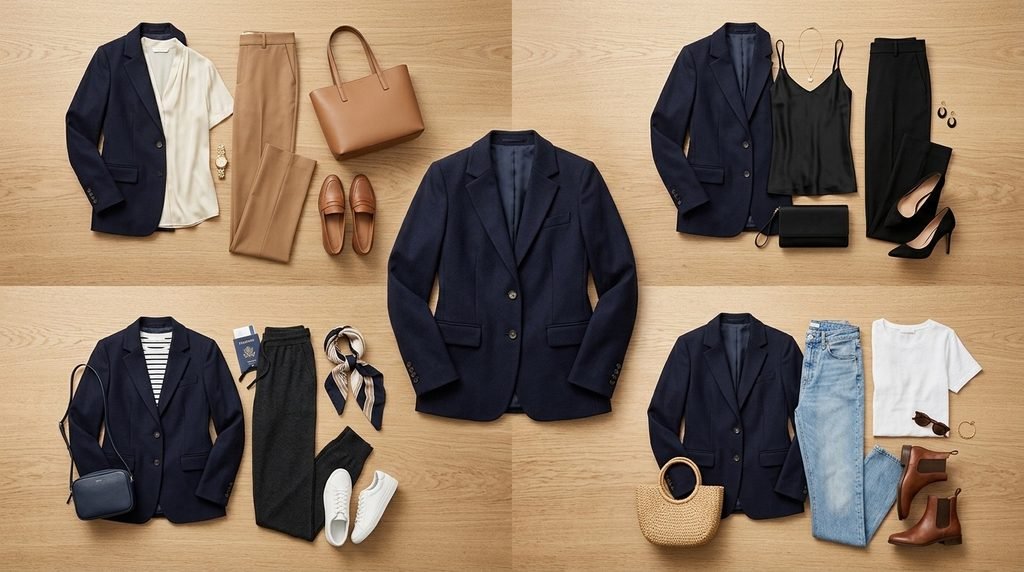
The most useful easy-care blazer isn’t necessarily the one that creates the most dramatic outfit. It’s the one that works with clothes you already reach for.

Business Casual

Pair a neutral blazer with straight-leg trousers, a simple knit shell and loafers or low heels. If the blazer has a softer construction, a tonal outfit underneath can keep the overall look polished without making it overly formal.

Travel Day

Try the blazer with a breathable tee or lightweight knit, dark trousers with comfortable movement and supportive shoes. Keep the jacket accessible rather than burying it deep in your luggage; you can wear it through the airport or place it on top of your bag’s contents.

Client Meeting

For a meeting where you want a little more structure, combine the blazer with tailored trousers or a midi skirt and a clean, uncomplicated top. A blazer with defined shoulders and a tidy lapel can provide visual polish even when its fabric offers stretch.

Dinner After Work

Swap the daytime blouse for a fitted knit or simple camisole where appropriate, add jewelry and change shoes. This is where an understated blazer often earns its place: the jacket doesn’t need to change for the outfit to feel different.

Smart Weekend Outfit

A blazer can also work over a plain tee with straight or relaxed jeans. Keeping the base outfit casual makes the structure of the jacket feel intentional rather than office-only.

What Machine Washable Really Means
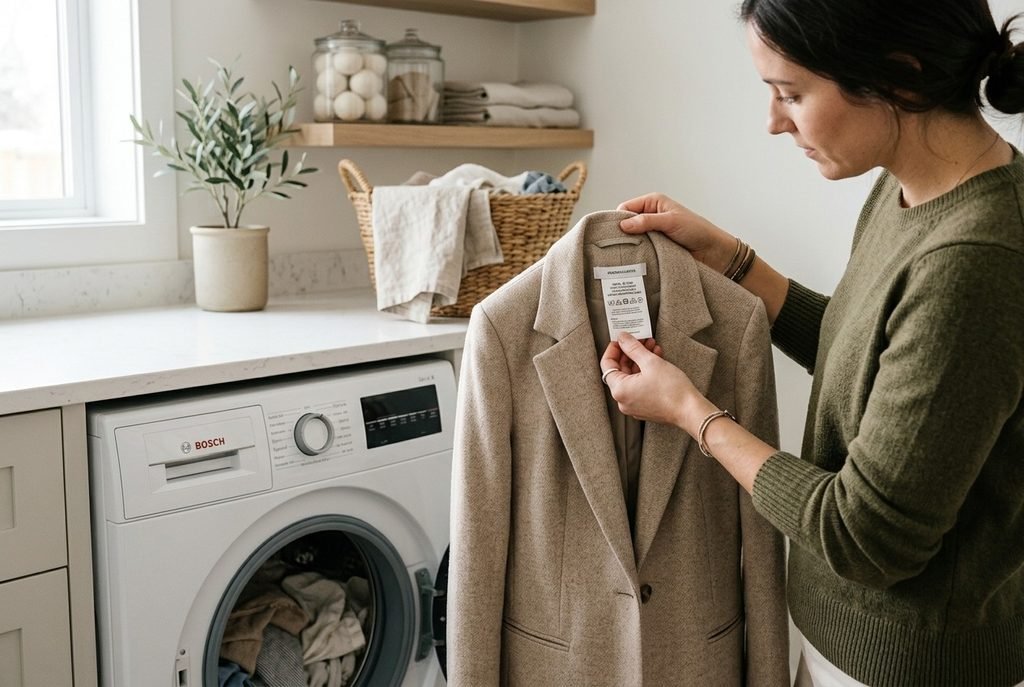
Machine washable means the garment’s stated care procedure permits machine washing. It does not automatically mean every washer cycle, temperature, detergent, drying method or finishing technique is suitable.

That distinction matters with blazers because the garment may contain more than one material. The outer fabric, lining, interfacing, shoulder structure, buttons, trim and other components all have to function as a finished garment. FTC guidance specifically notes that care instructions must take components such as non-detachable linings, trim, buttons and zippers into account.

Before washing any blazer:

  • Read the complete care label every time you buy a new style.
  • Check the specified wash method and temperature.
  • Follow any warnings about bleach, ironing or drying.
  • Don’t assume tumble drying is permitted merely because machine washing is.
  • Follow product-specific directions about fastening buttons, zippers or other closures if provided.
  • Use air drying only when compatible with the garment’s instructions; don’t invent a gentler-sounding method that contradicts the label.

If you no longer have the care information, check the manufacturer’s verified instructions before experimenting.

Common Buying Mistakes

A good product description can help, but the fitting room—or a careful try-on after delivery—still tells you things a feature list cannot.

Common mistakes include:

  • Buying for standing fit only. A jacket that photographs well may pull badly while driving or typing.
  • Assuming any stretch means excellent mobility. Lining, armholes and pattern construction also influence movement.
  • Ignoring recovery. Fabric that stretches comfortably but stays distorted afterward may not remain polished.
  • Treating “wrinkle-free” as an absolute guarantee. Look for product-specific details and realistic expectations.
  • Reading “machine washable” as “wash however you want.” The label’s complete instructions still apply.
  • Sizing down to create waist definition. Excessive front pulling usually looks less tailored, not more.
  • Forgetting your usual base layer. A blazer fitted over a thin tank may feel cramped over the knit you actually wear to work.
  • Prioritizing sleeve length over shoulders. Sleeves can sometimes be addressed more easily than a fundamentally poor shoulder fit.
  • Buying for one outfit. If wardrobe efficiency matters, picture at least three existing combinations before deciding.

When a Stretch, Wrinkle-Resistant Blazer May Not Be the Right Choice

Convenience has tradeoffs.

If you’re dressing for a highly formal professional environment, a structured traditional suit jacket may provide the sharper silhouette you prefer. Likewise, shoppers who love natural luxury fabrics, substantial tailoring or architectural shaping may decide that home washability simply isn’t the priority.

Stretch can also be unnecessary if you wear a blazer briefly and rarely sit or move extensively in it. And a very soft, flexible jacket may not deliver the crisp shoulder line someone expects from classic suiting.

There is also no reason to pay for easy-care features you won’t use. If you happily dry clean a favorite blazer a few times a year and love the way it fits, a washable replacement isn’t automatically an upgrade.

How FashionDew Can Help You Shop More Confidently

FashionDew can be a useful place to explore fashion options as its catalog develops, but shoppers should still judge every blazer from the details attached to that specific item.

Before purchasing any future FashionDew blazer, look for clear information about material composition, available sizing, lining, length, fit, closure and care. If a listing uses terms such as “stretch,” “wrinkle-free” or “machine washable,” product-specific details should help you understand exactly what those claims mean for that garment.

At the time this guide was prepared, FashionDew’s publicly accessible homepage displayed a “Coming Soon” message, so no specific FashionDew blazer inventory, prices, sizing system, shipping terms, returns policy or garment-care claims are asserted here.

Frequently Asked Questions

Are machine-washable blazers actually practical?

Yes, particularly for people who wear blazers frequently and prefer home garment care. Their usefulness depends on the exact care requirements, though. A blazer that can be machine washed but requires other careful handling may still need more attention than expected. Always compare the complete care label with your normal laundry routine before buying.

Do stretch blazers look professional?

They can. Professional appearance depends more on fit, construction, fabric surface, shoulder shape, lapels and overall condition than on the mere presence of stretch. A stretch blazer that lies cleanly through the shoulders and torso can work well in many office and business-casual settings, while more formal situations may call for traditional structured tailoring.

How do you keep a blazer from wrinkling while traveling?

Avoid compressing the blazer more than necessary, fold it along its natural construction lines, and place it where heavy items won’t crush it. Hang the jacket soon after arrival. If wrinkles remain, use only a steaming, pressing or ironing method compatible with the blazer’s care instructions; heat that works on one jacket may damage another.

What should you wear under a women’s blazer?

For work, common options include a knit shell, blouse, fine-gauge sweater or simple crew-neck top. A tee can make the blazer feel more relaxed for travel or weekends. Whatever you choose, try the blazer with a similar layer before buying so you know the sleeves, shoulders and armholes still provide comfortable movement.

Should a blazer feel tight when buttoned?

A close fit can be intentional, but strong pulling isn’t a sign of good tailoring. When a blazer is designed to close, the button should fasten without pronounced horizontal strain, distorted lapels or discomfort through the bust and waist. Sit down after buttoning it as well; a blazer can appear correct while standing and feel restrictive in actual use.

Are wrinkle-resistant blazers good for work?

They can be particularly practical for work because sitting, commuting and carrying bags can create creases during the day. Wrinkle resistance can help a blazer stay presentable with less intervention, but performance varies by garment. Treat the claim as one buying factor alongside fit, recovery, construction and care requirements rather than as a guarantee of a crease-free day.

Can a machine-washable blazer go in the dryer?

Only if its care instructions permit it. “Machine washable” describes the washing method and does not by itself authorize tumble drying. U.S. care-label requirements address drying instructions separately where applicable, so read the entire label rather than stopping after the washing line.

Final Takeaway

A practical blazer should work while you’re moving, not just while you’re looking in the mirror.

For most shoppers considering an easy-care option, focus first on shoulder fit and arm mobility, then look at fabric recovery, lining, wrinkle performance and the complete care instructions. Machine washability can make frequent blazer wear far easier to manage, while stretch can improve comfort during sitting and commuting—but neither feature replaces good construction or the right fit.

And keep expectations realistic. A stretch, wrinkle-resistant blazer may be ideal for a busy office week or carry-on wardrobe, while a traditionally tailored jacket may still win for formal suiting and crisp structure.

As FashionDew adds fashion content and shopping options, use this guide as your checklist for comparing what genuinely fits your wardrobe and routine. Explore the FashionDew


Helena Grace

Helena Grace

Keep in touch with our news & offers

Subscribe to Our Newsletter

Recent Posts

quartz co. teslin recycled down winter jacket
Quartz co. Teslin Recycled Down Winter Jacket Review

A winter coat can look perfectly capable on a hanger and still be wrong for the way you actually spend January. Think about a cold morning commute: wind at the train platform, wet snow on the walk to work, an overheated coffee shop, then another stretch outdoors after dark. The Quartz co. Teslin Recycled Down …

Soia & Kyo Women's Blaire Packable Trench Coat
Soia & Kyo Women’s Blaire Packable Trench Coat Guide

You can love the idea of a trench coat and still leave it at home. A long, structured coat takes up space, becomes another thing to carry through an airport, and may feel excessive once the afternoon turns warmer than the morning. That's the practical problem behind the Soia & Kyo Women's Blaire Packable Trench …

more to come macie maxi dress
More to Come Macie Maxi Dress: Fit, Styling & Buying Guide

The More to Come Macie Maxi Dress is a sheer, unlined knit maxi from contemporary womenswear brand MORE TO COME. Revolve lists it in cream and black, with sizes XXS through XL and a 65% polyester, 35% cotton composition. Its strongest use case is warm-weather, vacation, beach, and intentionally sheer styling—not shoppers seeking a conventional …

Lv Anti-aging Moisturizer: What to Know in 2026 Bottom Line: lv Anti-aging Moisturizer refers to Livinz Medspa's LV Anti-Aging Moisturizer, a $86.99 firming and brightening face moisturizer featuring Lipochroman®, Chromabright®, and unspecified firming peptides. The jar image also mentions a retinoid and identifies the size as 1.7 fl oz/50 mL. The biggest issue isn't the ingredient story—it's transparency. The current listing doesn't provide a complete ingredient list, identify the retinoid, or publish detailed directions, so those details are worth confirming before you buy. Anti-aging moisturizers can make shopping oddly complicated. One jar promises antioxidant protection. Another talks about peptides. A third leans hard on brightening technology. After a while, a bathroom shelf can start to look like a chemistry experiment with nicer packaging. LV Anti-Aging Moisturizer brings several of those ideas into one product. That's interesting. But the useful question isn't whether the ingredient names sound advanced. It's what we can actually verify about the formula, what the evidence says, and whether an $86.99 moisturizer makes sense for your routine. Here's what the available information tells us—and where the blanks still are. What Is lv Anti-aging Moisturizer? lv Anti-aging Moisturizer is the search phrase pointing to LV Anti-Aging Moisturizer, a Livinz Medspa-branded facial moisturizer positioned for firming, brightening, hydration, and the visible signs of aging. Livinz Medspa is a medical-spa business with locations listed in New York and North Carolina and sells an assortment of LV-branded skincare products. The seller's current description highlights three main components: Lipochroman®, promoted for antioxidant activity. Chromabright®, promoted for the appearance of uneven pigmentation. Firming peptides, promoted for fine lines and firmness. Livinz also says the moisturizer hydrates and improves the appearance of lines, wrinkles, and age spots. Those statements should be understood as product marketing claims unless independent testing of the finished formula demonstrates them. There's another wrinkle—figuratively, this time. The current jar image states “Antioxidants and Retinoid,” but the product description doesn't tell shoppers which retinoid is present. That's not a trivial omission. Knowing the actual retinoid matters for sensitivity, routine compatibility, pregnancy precautions, and realistic expectations. lv Anti-aging Moisturizer at a Glance Feature What We Found Why It Matters Product type Firming and brightening antioxidant facial moisturizer It's positioned as a moisturizer with added cosmetic anti-aging benefits rather than a standalone treatment serum. Seller/branding Livinz Medspa / LV-branded skincare The finished-product manufacturer isn't identified on the current listing. Current listed price $86.99 That's premium-moisturizer territory, increasing the importance of formula transparency. Size 1.7 fl oz / 50 mL, shown on the official jar image A common full-size facial moisturizer quantity. Featured ingredients Lipochroman®, Chromabright®, firming peptides Gives the formula an antioxidant + brightening + peptide positioning. Retinoid Official jar image says “Antioxidants and Retinoid”; type/concentration not disclosed in webpage text Retinoid identity can materially affect how and when you use a product. Full ingredient list Not clearly disclosed on the current product page A significant limitation for sensitive skin, allergies, or active-heavy routines. Detailed directions Not clearly disclosed on the current page We shouldn't invent a frequency or application instruction on Livinz's behalf. Stock status Page displays “Sold out” but also a Buy Now control Confirm availability before planning a purchase. Finished-product clinical evidence No peer-reviewed trial specific to LV Anti-Aging Moisturizer was identified in the sources reviewed Ingredient research shouldn't be confused with testing of the complete formula. One small but telling detail deserves attention: the Livinz description refers to “Ultra Benefits®” inside a benefit statement for LV Anti-Aging Moisturizer. That may simply be leftover product copy. It may reflect a formulation relationship. The available evidence doesn't establish which, so the sensible move is to treat it as an unanswered question rather than construct a story around it. What's Inside lv Anti-aging Moisturizer? The verified ingredient story is narrower than the marketing language makes it sound. Livinz specifically identifies Lipochroman®, Chromabright®, and firming peptides. Beyond that, the current webpage doesn't give us a full formula to evaluate. Lipochroman®: an antioxidant with ingredient-level evidence Lipochroman-6 is a trade name associated with dimethylmethoxy chromanol, a synthetic antioxidant molecule structurally related to chroman compounds. PubChem lists LIPOCHROMAN-6 among the synonyms for dimethylmethoxy chromanol. Here's where separating laboratory science from skincare advertising becomes useful. A peer-reviewed study found that dimethylmethoxy chromanol could quench singlet oxygen in solution and reduce singlet-oxygen lifetime and emission in ex-vivo pig skin. That's legitimate evidence of antioxidant activity. It is not, however, a clinical trial demonstrating that LV Anti-Aging Moisturizer removes wrinkles or prevents photoaging in people. Livinz goes further in its product copy, describing Lipochroman as the “strongest antioxidant” and connecting it with protection from UV and pollutants. Those stronger superiority and outcome claims come from the seller and shouldn't be converted into independent facts without comparative clinical evidence for the marketed formula. Editorial read: Lipochroman makes the formula more interesting on paper, especially if you're interested in antioxidant skincare. But antioxidant test-tube performance isn't a substitute for knowing its concentration, vehicle, stability, or clinical performance inside this particular jar. Chromabright®: promising for tone, with important evidence limits Chromabright is associated with dimethylmethoxy chromanyl palmitate. PubChem lists “CHROMABRIGHT” as a synonym for that ingredient. Livinz says Chromabright decreases the appearance of uneven pigment and age spots and claims it is 50% more effective at skin brightening than kojic acid. It also attributes UVA, UVB, and HEV protection to the ingredient. Those are seller claims. There is some outside evidence behind the brightening concept. A scientific review of skin-lightening agents noted an in-vivo study in 20 Asian volunteers in which dimethylmethoxy chromanyl palmitate showed a brightening effect after 30 and 60 days. Still, that's a small ingredient study, not a controlled trial of LV Anti-Aging Moisturizer in a representative US consumer population. So the reasonable conclusion is more modest: Chromabright has an evidence-backed rationale as a cosmetic brightening ingredient, but we can't use that evidence to predict the magnitude of results from the finished LV product. Firming peptides: the exact peptide matters Livinz highlights “firming peptides” but doesn't identify those peptides in the current product description. Peptide skincare isn't automatically snake oil, nor is every peptide formula interchangeable. A 2026 systematic review and meta-analysis covering 19 randomized trials and 1,341 participants found improvements across some skin-aging outcomes, although the wrinkle effect was modest and much of that signal was driven by oral rather than topical polypeptides. The authors also called for larger, standardized trials. Earlier dermatology literature makes another practical point: for a topical peptide to matter clinically, the finished product needs to keep it stable, deliver it through the skin appropriately, and maintain biological activity. That's why “contains peptides” isn't enough information to judge an $86.99 cream. What about the retinoid on the jar? Here's where things get especially interesting. The official Livinz product photograph visibly says “Antioxidants and Retinoid.” Yet the current webpage's ingredient section doesn't name any retinoid at all. Retinoids are vitamin A derivatives, and some have substantially stronger evidence for visible photoaging than many cosmetic anti-aging ingredients. The American Academy of Dermatology notes that retinoids can help with mild fine lines, uneven pigmentation, and texture, but they can also irritate dry or sensitive skin. AAD also advises that retinoids should not be used during pregnancy. That makes the missing detail especially important. Before purchasing, ask Livinz: Which retinoid is in the current formula? What is its concentration? Is the photographed jar the current formulation? Is the moisturizer intended for morning use, evening use, or both? Has the formulation changed since the current photo was produced? Until those questions are answered, it would be premature to build an elaborate retinoid routine around this product. Other ingredients worth noticing—or rather, verifying A complete ingredient list is one of the most useful pieces of information a skincare shopper can have. It can reveal humectants, emollients, fragrance ingredients, botanical oils, preservatives, known allergens, additional actives, and ingredients that may overlap with the rest of your routine. That full list isn't present in the LV product-page text we reviewed. For someone with uncomplicated skin, that may be an annoyance. For someone who needs to avoid specific ingredients, it's a much bigger deal. What Benefits Can You Realistically Expect? The most realistic expectation is moisturized skin with possible improvements in the appearance of fine lines, brightness, and uneven-looking tone—not guaranteed wrinkle removal, lifting, or reversal of skin aging. It's useful to break the claims apart. Hydration Livinz says the moisturizer hydrates. That's entirely plausible for the product category, although the missing full INCI means we can't independently assess its moisturizing system. Moisturizers can make fine lines look softer because increasing skin hydration temporarily plumps the surface. The American Academy of Dermatology specifically notes that moisturizer can reduce the appearance of some fine lines and make the complexion look brighter. That isn't the same as permanently restructuring a wrinkle. Fine lines and wrinkles Livinz markets peptides and other ingredients for the appearance of fine lines and wrinkles. Ingredient science makes that plausible as a cosmetic goal, but there's no verified finished-product trial here establishing how much improvement to expect. If the product truly contains an effective retinoid at an appropriate concentration, that could materially strengthen the anti-aging case. But we don't know which retinoid the current jar contains. So “may improve the appearance of fine lines” is defensible. “Reverses wrinkles” is not a conclusion the available evidence supports. Firmness Firming creams deserve especially realistic expectations. AAD notes that results from skin-firming creams tend to be subtle at best and that a cream cannot literally lift sagging skin the way a procedure might. Some immediate “firming” effects can simply come from moisturized skin appearing temporarily plumper. That's a useful reality check for this product's peptide positioning. Brightness and uneven-looking tone Chromabright gives this formula a more specific brightening story than a basic moisturizer. The available ingredient research suggests a plausible effect on the appearance of pigmentation, but the small human evidence base and absence of an LV-specific trial mean expectations should stay moderate. If you're dealing with persistent or changing pigmentation rather than routine cosmetic dullness, that's also a different conversation from simply choosing a moisturizer. Antioxidant support Lipochroman's antioxidant activity has legitimate laboratory support. What isn't established is exactly how much antioxidant benefit the finished moisturizer delivers on human skin under everyday conditions. Concentration, formulation, packaging, stability, and application all matter. Ingredient buzzwords can't answer those questions by themselves. What about the UV-protection claims? Do not treat LV Anti-Aging Moisturizer as your sunscreen based on the ingredient claims currently published. Livinz attributes UV-related protective benefits to Lipochroman and Chromabright, but the product page does not present LV Anti-Aging Moisturizer as a conventional broad-spectrum SPF product with an SPF value. FDA distinguishes ordinary cosmetic claims from sunscreen/drug claims, and US sunscreens are subject to specific labeling and testing requirements. AAD recommends a broad-spectrum, water-resistant SPF 30 or higher as part of an anti-aging routine. In everyday terms: antioxidants can complement sunscreen. They don't replace it. Who Might Like lv Anti-aging Moisturizer? This product may make sense for shoppers who: Want one moisturizer with antioxidant, brightening, and peptide positioning rather than a bare-bones hydration formula. Are primarily concerned with the cosmetic appearance of dryness, mild fine lines, dullness, or uneven-looking tone. Already understand that daily sunscreen remains essential. Don't mind paying a premium if the ingredient story and eventual full formula meet their needs. Are willing to contact the seller and verify the missing INCI and retinoid details before committing. Prefer a moisturizer-based anti-aging step rather than adding multiple separate serums. The key phrase is may make sense. Without a full formula and confirmed retinoid identity, there isn't enough information to confidently match this product to every skin type. Who Should Think Twice? A few shoppers have good reasons to slow down before ordering. You're sensitive to active ingredients The jar's retinoid statement matters. Retinoids can irritate skin, particularly when you're starting out or when they're combined too aggressively with other active products. If your skin is easily irritated, don't assume the formula will be gentle simply because it is sold as a moisturizer. You need to avoid specific allergens or fragrance The current Livinz listing doesn't give us a full INCI list. That means a shopper who needs to avoid a particular preservative, botanical, fragrance ingredient, or other sensitizer can't make an informed decision from the page alone. Ask for the current packaging ingredient list, not merely a summary of featured ingredients. You're pregnant Because the current jar image mentions a retinoid, this is a product to verify before use during pregnancy. The AAD advises against retinoid use during pregnancy. You expect a cream to lift sagging skin That's beyond what a cosmetic moisturizer should realistically promise. Topical firming products may subtly improve appearance, but AAD notes that creams cannot truly lift sagging skin. You want maximum ingredient transparency for your money At $86.99, wanting the full ingredient list, current formula, intended frequency, and active details isn't nitpicking. It's reasonable shopping due diligence. You need treatment for a persistent skin problem Cosmetic moisturizers and medically directed treatment aren't interchangeable. FDA notes that products making claims about changing skin structure or function cross into drug territory rather than ordinary cosmetic claims. For a concern that isn't improving with routine skincare, a dermatologist can help identify what type of intervention actually fits. How to Use It in a Skincare Routine The Livinz product page reviewed doesn't provide clear manufacturer-specific application directions, so it would be misleading to invent an official twice-daily schedule. What we can give you is a sensible category-level routine position for a facial moisturizer. Cleanse. Use a gentle cleanser appropriate for your skin. Apply any compatible treatment or serum. This could be a simple hydrating serum or another established treatment in your routine. Apply your moisturizer. This is where LV Anti-Aging Moisturizer would normally fit. In the daytime, finish with broad-spectrum SPF 30 or higher. Don't count the moisturizer's antioxidant or “UV protection” ingredient language as sunscreen. There's an extra caveat here: verify the retinoid first. If Livinz confirms that the current moisturizer contains a retinoid, its identity and strength should guide how you introduce it. AAD generally advises starting retinoids slowly, paying attention to dryness and irritation, and using sun protection during the day. If you're already using retinol, prescription tretinoin, strong exfoliating acids, or other potentially irritating products, knowing what's actually inside this moisturizer becomes even more important. Is lv Anti-aging Moisturizer Worth the Price? It depends on how much you value the ingredient concept versus formula transparency. The $86.99 price and 50 mL jar work out to roughly $1.74 per mL, placing the moisturizer well above basic drugstore pricing. On paper, there are reasons to be interested: Lipochroman has genuine antioxidant research behind its ingredient. Chromabright has at least some human brightening evidence. Peptides can be useful in well-designed topical formulas. A genuine retinoid could add a more evidence-backed anti-aging component. But premium skincare should be judged on more than an attractive active-ingredient headline. At this price, we'd want to know: The complete current INCI list. The exact retinoid. Active concentrations where the brand is willing to disclose them. Whether the photographed packaging reflects the current formula. Recommended frequency. Compatibility guidance. Product-specific human testing, if any exists. That's the trade-off. The formulation concept looks more interesting than a generic moisturizer, but the current disclosure doesn't make it easy to judge whether it earns its premium price. And no, a higher price alone isn't evidence of a better formulation. What Makes FashionDew's Approach Useful? For this article, FashionDew's useful role is editorial rather than experiential. This is not being presented as a hands-on product review, and no first-hand testing has been invented. Instead, the analysis separates four things that skincare pages too often blur together: What the seller says. Livinz makes specific claims about firming, brightening, antioxidants, peptides, and visible aging. What independent research supports. Some featured ingredient concepts have scientific support, but the strength and relevance of that evidence varies. What we still don't know. The complete formula, retinoid identity, directions, manufacturer, concentrations, and finished-product clinical evidence remain unclear. What that means when you're spending your own money. Instead of asking whether an ingredient sounds impressive, ask whether the product provides enough information to judge compatibility, evidence, and value. That's a much more useful standard than simply counting trendy actives on the front of a jar. Questions to Ask Before Buying Before you add LV Anti-Aging Moisturizer to your cart, consider asking: Can Livinz provide the complete current INCI ingredient list? Which retinoid is referenced on the jar? What concentration of that retinoid is used? Is the product intended for morning, evening, or twice-daily application? Is the 1.7 fl oz/50 mL jar shown online the current formulation and packaging? Does the formula contain fragrance, essential oils, or ingredients you personally avoid? Are there any compatibility recommendations for people already using retinol, prescription retinoids, exfoliating acids, or benzoyl peroxide? Has the finished LV moisturizer, rather than just its individual ingredients, undergone controlled human testing? What explains the “Ultra Benefits®” wording on the LV product page? Is the item currently in stock, given the conflicting “Sold out” and “Buy Now” signals on the listing? If UV protection is being claimed, what tested SPF or regulated sunscreen labeling supports that claim? Those answers would tell you considerably more than another paragraph about “youthful-looking skin.” lv Anti-aging Moisturizer FAQs What does lv Anti-aging Moisturizer do? LV Anti-Aging Moisturizer is marketed by Livinz Medspa to hydrate, brighten, firm, and improve the appearance of fine lines, wrinkles, and uneven-looking pigmentation. Its highlighted ingredients are Lipochroman®, Chromabright®, and firming peptides. Those benefits are seller claims; independent clinical results for the finished LV moisturizer weren't identified in the research reviewed. Is lv Anti-aging Moisturizer good for mature skin? Potentially, but “mature skin” alone isn't enough to determine fit. Its hydration, antioxidant, brightening, peptide, and possible retinoid positioning is relevant to concerns that often accompany visible skin aging. The bigger issue is that the current product page doesn't disclose the complete formula or clearly identify the retinoid, making sensitivity and compatibility harder to assess. Can I use lv Anti-aging Moisturizer every day? The current Livinz product page reviewed doesn't clearly publish an official application frequency, so we can't responsibly state that the manufacturer instructs daily or twice-daily use. The jar's retinoid wording is another reason to verify directions with Livinz first, particularly if you already use other active skincare products. Does lv Anti-aging Moisturizer help wrinkles? It may help the appearance of fine lines, but guaranteed wrinkle removal isn't supported. Moisturization alone can temporarily make fine lines less noticeable, while peptides and retinoids can have additional benefits depending on the specific ingredient, concentration, stability, and formulation. The finished LV product doesn't currently have independently verified wrinkle-treatment results in the sources reviewed. Does lv Anti-aging Moisturizer contain retinol? We can't verify that it contains retinol specifically. The official jar image says “Antioxidants and Retinoid,” but Livinz's current web description does not identify the retinoid. “Retinoid” is a broader category than “retinol,” so those terms shouldn't be treated as interchangeable here. Should I still use sunscreen with it? Yes. Don't substitute this moisturizer for a dedicated sunscreen based on antioxidant or UV-related ingredient claims. For daily anti-aging sun protection, the American Academy of Dermatology recommends broad-spectrum, water-resistant sunscreen with SPF 30 or higher. Is LV Anti-Aging Moisturizer the same as Ultra Benefits? That cannot be verified from the available evidence. The Livinz product page unexpectedly uses the name “Ultra Benefits®” in one benefit statement, and other products on the market use similar Lipochroman/Chromabright/peptide positioning. But similar copy does not prove that the formulas, manufacturers, or products are identical. Ask Livinz directly if that distinction matters to your purchase. Is lv Anti-aging Moisturizer worth $86.99? It may be worth considering if you specifically want its antioxidant-and-brightening concept and the seller can provide satisfactory answers about the full formula and retinoid. At this price, though, the current lack of complete ingredient and usage disclosure is a meaningful drawback. A premium price doesn't automatically mean stronger clinical evidence or better results. Final Verdict lv Anti-aging Moisturizer has an intriguing ingredient story, but the unanswered formula questions matter almost as much as the featured actives. Lipochroman provides a legitimate antioxidant rationale. Chromabright has some ingredient-level brightening evidence. Peptides can contribute to a well-designed anti-aging formula. And the retinoid statement on the jar could be significant. The problem is that shoppers currently have to piece too much of that story together themselves. The complete ingredient list isn't clearly published. The retinoid isn't identified. Detailed instructions are missing from the page. The seller makes substantial claims around UV protection without presenting the moisturizer as a standard SPF product. And the product copy contains an unexplained “Ultra Benefits®” reference. For an $86.99 moisturizer, those aren't insignificant details. If Livinz provides a current INCI list and clarifies the retinoid and usage instructions, you'll be in a much better position to decide whether the formula deserves a place in your routine. Until then, the most defensible verdict is promising ingredient concept, incomplete purchasing information. Explore more FashionDew beauty and style guides as the site's editorial library grows for straightforward, evidence-aware breakdowns designed to make product research easier.
Lv Anti-aging Moisturizer: What to Know in 2026

lv Anti-aging Moisturizer refers to Livinz Medspa's LV Anti-Aging Moisturizer, a $86.99 firming and brightening face moisturizer featuring Lipochroman®, Chromabright®, and unspecified firming peptides. The jar image also mentions a retinoid and identifies the size as 1.7 fl oz/50 mL. The biggest issue isn't the ingredient story—it's transparency. The current listing doesn't provide a complete …

Comments

Leave a Reply

Your email address will not be published. Required fields are marked *